Sunday, 6 September 2015

The Canterbury Tales ~~ The Merchant's Prologue and Tale

Oh, the poor Merchant.  Married only two months and he swears that there is no one in existence as miserable as he.  His wife's cruelty is unsurpassed, and he urges all men to avoid the matrimonial state if at all possible.

"Never again, never again the snare!
We married men, our life is grief and care.
Try it who will, and he will find, I promise
That I have spoken truly, by St. Thomas,
For most of us -- I do not say for all,
And God forbid that such a thing befall"

Middle English:

"I wolde nevere eft comen in the snare.
We wedded men lyven in sorwe and care.
Assaye whoso wole, and he shal fynde
That I seye sooth, by Seint Thomas of Ynde,
As for the moore part -- I sey nat alle.
God shilde that it sholde so bifalle!"

The Host wittily reparts that since the Merchant is a marriage expert, he must certainly tell his tale.  The Merchant agrees but cautions that he has said all he will of a personal nature.

The Merchant
source Wikimedia Commons


The Merchant's Tale


Battle of Pavia (after 1525)
Unknown Flemish Artist
source Wikimedia Commons
In Lombardy, in the town of Pavia, lived a well-respected knight named January.  He had remained a bachelor for sixty winters, but in his old age decided that he would like nothing better than to marry. He highly praised the married state in spite of Theofrastus' injunctions and warnings against it.

"This opinion, and a hundred things worse,
Writes this man, may God his bones curse!
But take no heed of all such foolishness;
Defy Theofrastus, and listen to me."

Middle English:


This sentence, and an hundred thynges worse
Writeth this man, ther God his bones corse!
But take no kep of al swich vanytee;
Deffie Theofraste, and herke me.

January & May
©Trustees of the British Museum
He goes on to list the value a wife brings to a home, and councils men to always obey their wives in everything.  However, he has a number of requirements for his wife, in that she must be young, so he will not be driven to adultery, and not a widow, so she does not resort to trickery.  He pleads with his friends to help him in his quest, yet stife is stirred up between his two friends, Placebo (meaning "I shall please"), and Justinus (meaning, "the just one"). Placebo defers to January's opinion on the matter, since he is his lord, yet Justinus cautions to choose a wife wisely, taking time and care, otherwise a man may regret his choice as he so rightly knows, as he is married and is subject only to a life of cares and duties.

January prefers Placebo's advice, which echoes his own and, thoroughly obsessed with his goal, begins his search for a wife.

"Exaggerated imagination and constant thought
From day to day became fixed in the soul
Of January concerning his marriage."

Middle English:

Heigh fantasye and curious bisynesse
Fro day to day gan in the soule impresse
Of Januarie aboute his mariage.

January helping May into the tree
Warwick Goble
He finds the perfect wife in May, a poor yet fair girl, but January is tormented by another thought.  It is said men cannot experience bliss twice and he is concerned that all the happiness he is sure to find with his wife, will then be denied to him in Heaven.  Justinus assures him that will not be the case, and, in fact, he can take comfort in the fact that his marriage will probably be a purgatory.

And so "tender youth has wedded stooping age" and all around them is mirth ..... and, of course, Chaucer's playful spirit.  The wedding is described in detail, but January wishes it to end so he can slake his amorous desires on his new wife. Chaucer ensures that the descriptions of January are unflattering and lecherous, to place the reader into May's viewpoint, and as January spends hours satisfying his passion with her and assuring her that he can do no wrong in the eyes of the law, she finally takes to her room and locks herself in for four days.

Yet there is a serpent in Eden and his name is Damian, the knight's squire who is so enamoured of May "that for the very pain he was nearly crazy."  January, believing that Damian is truly sick, visits him with May, whereupon Damian secretly give her a letter and she learns of his passion for her.

Meanwhile January decides to build a walled garden and he is the only one to possess the key.  But soon after January loses his eyesight, and one day he suggests that he walk with his wife in this garden.  Unbeknownst to him, May allows Damian to slip inside the garden, too.  He climbs up into a pear tree to await their assignation.  Meanwhile, the god Pluto and his queen Proserpine wander by and get into an argument, each giving examples of the treachery, deceit and sin of the opposite sex while supporting their own, thereby showing that the only true, good and perfect being is God.

Back to January and May, the latter who convinces her husband to let her climb on his back to get some pears in the pear tree.  While up there, Damian has sex with her, but lo, Pluto returns January's sight and what meets his eyes causes him to explode in rage. Gentle May must reassure her husband that she is the cause of his regained sight and that since he has been blind for so long, what he sees at first is likely to be not at all accurate.  She is able to restore January's faith and the story ends.  I cannot but think that the two of them deserve each other.

What a fabulous tale and one that could be studied in great depth.  Each line could be chewed over, and the allusions are numerous: from Esther to Solomon and from The Romance of the Rose to Venus, there are so many wonderful trails of stories from here that one could be kept busy for ages. January's physical blindness certainly echoes his intellectual blindness towards the matrimonial state.  We may feel sympathy for January that he is unable to see his wife's plotting and tryst, yet even Chaucer mentions that Argus who had one hundred eyes was deceived, again implying that January's blindness is not merely a physical condition, but a condition of the heart.  He willfully chooses blindness and the outcome would not have been different even if he had the use of his eyes.  It reminded me of the play Oedipus Rex by Sophocles, another case of physical blindness paralleling a spiritual blindness.  Bravo, Chaucer!  This is my favourite tale so far!


Tuesday, 1 September 2015

The Canterbury Tales ~~ The Clerk's Prologue and Tale

The Host prods the Clerk on to his tale, but gives a list of cautionary advice for his telling of it: cheer up, don't be boring, be entertaining, but for heaven's sake don't be too clever rhetorically.  It's interesting that the Clerk receives instructions which no one else has needed.

The Clerk of Oxford mollifies the Host, and then announces that his tale will come from a Paduan, in fact Francis Petrarca (Petrarch), who related it to him personally.  This tale is also included in Boccaccio's The Decameron on the tenth day.

The Clerk of Oxenford (Oxford)
source Wikimedia Commons

The Clerk's Tale

Part I


On the western shores of Italy lived a marquis who ruled his vassals with fair hand and therefore was loved by all.  Handsome and strong, he took delight in pleasure and shunned serious cares.  Yet the lack of his inclination to marry, worried his subjects and they appealed to him wed to secure his line and therefore, safety for his kingdom.  The marquis agreed on the condition that he was allowed to choose his future bride.  His subjects, a little worried about this demand and thinking that he would delay, requested that he name a date for his wedding.  He agreed and they were placated.

The Proposal (The Marquis & Griselda) (1850)
Frederic George Stephens
source


Part II


Adding to the people's consternation, the marquis, Walter, chose a poor girl to be his bride, gaining a promise from her to obey him with joy in all things.  Her name was Griselda and she was steeped in virtue, benevolence, and forbearance.  All admired her, and in her manner, so carefully crafted, she had the bearings of royalty.  The Marquis was admired for his ability to see virtue within her, despite her trappings of poverty, and by her virtuous character, she was beloved of all the people.  She was eventually delivered of a girl and, although a boy would have been preferred, the kingdom rejoiced.

Part III


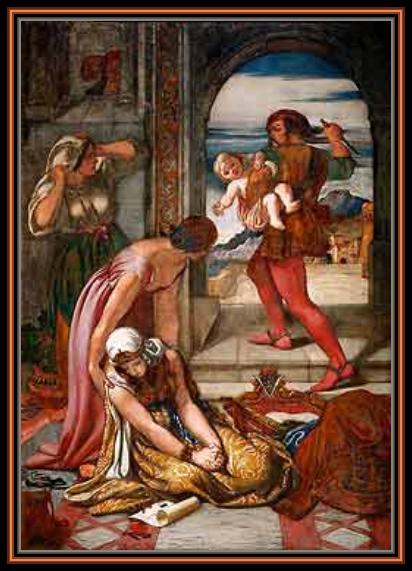
Obsessed by his wife, the Marquis decided to test her constancy and, in an act of extreme cruelty (yes, I'm inserting my opinion here, which I normally don't like to do, but I was quite appalled by this story), had the dear child ripped from his wife's arms, making her believe that the girl was being taken to be killed because the people disliked the thought of the child's heritage of poverty. Griselda, as she had promised submission to her husband, showed no emotion, only asking that the child be buried where wild animals were unable to tear it asunder.  The Marquis clandestinely had the child taken to his sister's house in Bologna, and then watched for any enmity or disquiet from his wife, yet still she treated him with kindness and reverence.

A Parental Kidnapping - Griselda
source Wikimedia Commons

Part IV


Another four years passed and Griselda gave birth to a boy.  Walter, once again, decided to test his wife, performing the same actions as with his infant daughter.  Is this shocking?  Wait!  There's more.  In addition to his sadistic actions, he fraudulently produced a Papal Bull of annulment, which allowed him to divorce Griselda and marry another.  He announced the arrival of his new wife-to-be, but in fact, secretly called for his two children's return from Bologna.  His new bride would, in fact, be his twelve-year-old daughter. Murmurs begin among the people, however, that Walter was the true murderer of his children.

Part V


Again, Griselda supported her husband's choices since he believed that they would bring him happiness, and returned to her father's house dressed in only a simple smock.

Part VI  


Walter enlisted Griselda to prepare his new bride-to-be for marriage and she complied.  Once the people viewed his new bride-to-be, they quickly changed their allegiance and supported the marquis' choice, whereupon the Clerk expresses outrage against these fickle people.  However, Walter was now unable to bear his own inhumane actions towards his wife any longer; he confessed all, Griselda was reunited with her children and all lived in harmony hereafter.  

Episode of the Story of Griselda (1445-1450)
Francesco di Stefano Pesellino
source Wikimedia Commons


Chaucer's Envoy to the Clerk's Tale

In an astonishing reversal, the Clerk took another tact for the envoy.  Claiming that both Griselda and patience are now dead, he ironically entreated wives not to behave like Griselda, nor husbands to behave like Walter.  In fact, he seemed to encourage rather undesirable female stereotypes: wives who berate or have little respect for their husbands.

The Clerk
source Wikipedia

In the fourteenth century, a French soldier and author, Phillipe de Mézières, translated Petrarch's tale into French, adding a prologue that represents Griselda's story as an allegory for the soul's love for Christ, echoing many Biblical scriptures, such as:

Blessed is the man who remains steadfast under trial, for when he has stood the test he will receive the crown of life, which God has promised to those who love him.  James 1:12

Rejoice always, pray without ceasing, give thanks in all circumstances; for this is the will of God in Christ Jesus for you.  1 Thess. 5:16-18

Blessed are those who are persecuted for righteousness' sake, for theirs is the kingdom of heaven. Blessed are you when others revile you and persecute you and utter all kinds of evil against you falsely on my account. Rejoice and be glad, for your reward is great in heaven, for so they persecuted the prophets who were before you.  Matt 5:10-12

The Story of Patient Griselda
source Wikipedia
I haven't read Petrarch's original tale, but Mézières' supposition encounters some difficulties when applied to The Clerk's Tale.  In Scripture, the sufferings are a result of a fallen world and it is God's love and grace that sustains his people. Conversely, in The Clerk's Tale, it's the Marquis who is testing his wife due to obsessive insecurities.  I don't see a parallel between them.

So what is Chaucer doing with this tale? He likens Griselda's story to Job so it appears as though he's advocating for strength and perseverance in adversity. While Griselda's mild responses to her husband's torture are rather appalling, what would have happened if she had given a different response and stood up to his tyrannical machinations?  At the least, her husband most likely would have disposed of her and at the worst, perhaps her children, as well.  By her measured responses, but most of all, by keeping her initial promise to him, she eventually receives a life of happiness and contentment and love.

Also, the contradictions between the tale and envoy suggest a playfulness that is customary in Chaucer's tales.  Perhaps he wants us to get tied up in conjectures, exhausted by ambiguity, teased by the tales' quick turns and bawdy wit, and finally lost in a forest of comedic and somber rhetoric.  And then he laughs at us.  Honestly, I wouldn't be surprised .......


Friday, 28 August 2015

Sense and Sensibility by Jane Austen

"The family of Dashwood had been long settled in Sussex."

Mr. Dashwood of Norland Park has passed away leaving his wife, Mrs. Dashwood, and three daughters, Elinor, Marianne, and Margaret to the mercy of their half-brother, John Dashwood, now owner of their ancestral home.  While John had promised his father to care for his step-mother and sisters and settle money on them for their comfort, he is quickly and deftly talked out of giving them anything by his mercenary wife. The Dashwood family is left to accept Barton Cottage, a small cottage in Devonshire, offered to them by a distant cousin, Mr. Sir John Middleton.  Yet before they leave Norland, Elinor forms an attachment with Edward Ferrars, the brother of her callous sister-in-law, a good-natured young man, who appreciates Elinor's sense and temperance.

At Barton Cottage, the family meet their benefactor, Sir John, a rather buffoonish cordial man, with a wife with a character as warm as winter. Despite their reduced circumstances, the Dashwoods accept their new life with, more-or-less, a cheerful resignation and begin to move about in society, meeting the dour and grave Colonel Brandon.  Brandon is attracted to Marianne, but at thirty-five years old, he seems rather ancient to her, and his disposition does not exemplify all the sensitivity, feeling and passion that she considers essential in a man.  During an accident in the rain, Marianne is rescued by a young gentleman, Willoughby, and his nature, in contrast to Brandon's, appears to be everything her heart desires.  His love of books, music and poetry correspond identically to hers; his impulsiveness and his carefree love of pleasure; his immoderate abandon in the face of love.  Their marriage soon appears to be a surety, but when Marianne learns of his engagement to another, her heart and all her preconceived ideals are damaged.

Meanwhile, Edward Ferrars pays a visit, yet while Elinor feels an ardent connection between them, Edward appears indecisive.  She soon learns of his engagement to a Miss Lucy Steele and, contrary to Marianne's disposition, she is forced to suppress her natural feeling for the sake of convention, but also self-respect.

Gathering Flowers in a
Devonshire Garden
John William Waterhouse
source Wikiart
The juxtaposition of sense and sensibility is played out and embodied in the characters of Elinor and Marianne.  Elinor's sense is soon made apparent.  "Elinor, the eldest daughter whose advice was so effectual, possessed a strength of understanding, and coolness of judgement, which qualified her, though only nineteen, to be the counsellor of her mother, and enabled her frequently to counteract, to the advantage of them all, that eagerness of mind in Mrs. Dashwood which must generally have led to impudence.  She had an excellent heart; her disposition was affectionate, and her feelings were strong: but she knew how to govern them: it was a knowledge which her mother had yet to learn, and which one of her sisters had resolved never to be taught."

Marianne, in contrast, is all unbridled sensibility, and shows a contempt for those who are not as passionate.  While her sensibility is a sensation of passion induced by positive emotions and experience, such as love, poetry, music, and a response to beauty, it is a wild impulsive, unrestrained, vehement emotion, and Marianne allows herself to be governed by it entirely.  As young colt strains against the teaching rein, so Marianne pulls against the constraints that society places on her as a young woman in Georgian England.

London (1808)
William Turner
source Wikiart
Yet while Austen shows the differences and consequences of the two character traits, with her usual insights and character crafting she does not put either sister in a tidy box.  While Marianne is wild and impulsive, she also show glimmers of sense.  As her character develops, Willoughby's true nature is revealed to her, and through him her own nature is reflected back into her eyes.  She recognizes her faults and strives for change.  Conversely, it is not that responsible, pragmatic Elinor doesn't feel; she has similar strength of emotion and attachment as her sister, but her emotions are bridled.  Elinor's sensibility is there, but it does not overpower her sense and therefore allows her to see situations in a clearer light, and from that she is able to govern her life in a way that not only brings respect and contentment to herself, but is beneficial for those people around her.

As usual, Austen gives us a kaleidoscope of characters and while there is strict delineation between the different levels of society, she also shows the colourful interactions that cross those boundaries between them.  She juxtaposes two situations, one were engagements are incorrectly assumed for both sisters, and then the turmoil of both sisters when it is known that Willoughby and Edward are engaged to other women.  Yet it is the characters that offer us a lesson, as their behaviour determines the outcomes of each situation, and gives us an intimate look at the correct balance of both "sense" and sensibility".


Wednesday, 26 August 2015

Hamlet Read-Along


Finally, Hamlette at The Edge of the Precipice is having her promised Hamlet Read-Along and I am so in!  This play is one of my favourites of Shakespeare's.  Is Hamlet mad or is he incredibly deceptive, that is the question?


I've read this play one and a half times already, so this time I'll be able to dig even deeper into the characters' psyches.

Hamlette has also compiled a list of books to read which deal with the play in her post Hamlet 101.  If you are looking for some extra reading, please check out her list.

So whether you are a Shakespeare aficionado or are reading him for the first time, please join us on October 1st for the Hamlet Read-Along.   Personally, I can't wait!


Tuesday, 25 August 2015

Classics Club Spin #10 ............. And the Winning Number is ...........


 Number 5


So the book that I'll be reading is The History of Napoleon Buonaparte by John Gibson Lockhart.


I'm actually very excited about this choice because it gives me an opportunity to finish this book that I'd already begun to read and had set aside, AND because I'm able to read a non-fiction choice.  I really love non-fiction (and history), yet rarely have the time to read it; my pitiful performance in my Non-Fiction Adventure Challenge will attest to that.

I'm looking forward to spending some time with the great man, Napoleon!


Monday, 24 August 2015

The Canterbury Tales ~ The Summoner's Prologue and Tale

After the Friar finished his story, the Summoner calls in question its veracity, by aligning the Friar with fiends, claiming that they keep good company.  He relates a rather deprecating story about an angel taking a friar through Hell and, upon seeing not one Friar and asking if all Friars were saved, the angel has Satan lift up his tail and, exposing his anus, out flies from there twenty thousand Friars.  Having sufficiently insulted the Friar's occupation, the Summoner tells his tale.


The Summoner
source Wikimedia Commons


The Summoner's Tale

There was a Friar in the area of Holdernesse, who travelled around receiving gifts from the people in return for his promised prayers, which he never remembered to give.  Upon visiting a church member, Thomas, the Friar fondles his wife and listens to her complaints about her husband's illness and his bad temper.  He assures her that her dead child went to heaven because he saw it in a vision, and then proceeds to sermonize about how fasting brings moral purity and gluttony, corruption.  His sermons continue to Thomas, as he tries to convince him to give more money to the church to relieve his sufferings, and goes on, ad nauseum, about the glorious virtues of friars.  He berates Thomas for his anger and employs the extensive use of classic examples to support his points.

The Friar and Thomas (1787)
John Mortimer
Finally, Thomas, disgusted beyond measure by the pomp and officiousness contemptibility of the Friar and his "false dissimulation", tells him that he has a gift and that he will give it to him only upon the condition that he promises to share it with the other friars.  The Friar readily agrees and Thomas instructs:

"'Now then, put in they hand down by my back,'
Said this man, 'and grope well behind.
Benearth my buttock where shalt thou find
A thing that I have hidden in private.'"

Middle English:

"'Now thanne, put in thyn hand doun by my bak,'
Deyde this man, 'and grope wel bihynde.
Bynethe my buttok there a shaltow fynde
A thyng that I have hyd in pryvetee'."

The Friar reaches between the cleft of Thomas' buttocks, but the gift is not what he expected:

"Amid his hand he let the friar a fart;
There is no horse, pulling cart,
That could have let a fart of such a sound."

Middle English:

"Amydde his hand he leet the frere a fart;
Ther nys no capul, drawynge in a cart, 
That myghte have lete a fart of swich a soun."

An Augustinian Friar Praying
Gerard David
source Wikiart
Enraged, the Friar takes himself off and comes upon a Lord with his Lady; he freely shares his ire prompted by this insulting action. Both are shocked, but the Lord is more perplexed by the scientific problem:  Can a fart be shared?  His servant comes to the rescue, suggesting using a cartwheel with twelve spokes and, if one puts each of the friars at the end of the spokes and then get the churl (Thomas) to fart in the "nave", the resulting stink can be shared by all.  All, except the Friar, are impressed with the servant's brilliant answer.

The pilgrims are almost at town and the Summoner announces that his tale is done.

Both the Summon and the Friar are portrayed as hypocrites, saying one thing, while their actions portray another.  Instead of being concerned with the souls of people, they are only interested in their own well-being and comfort.


Saturday, 22 August 2015

Classics Club Spin #10

I wasn't going to participate in this Classics Club Spin.  I am so behind with my reading due to various family matters that have taken up unusual amounts of time.  Add to this, a very busy fall, and common sense told to me skip the Spin this time around.  However, when have I listened to common sense when it comes to books .........??


So I went to my Classics Club list, sorted it with the random generator, and came up with my list.

  1. The Pickwick Papers (1836 - 1837) - Charles Dickens
  2. The Heart of Darkness (1899) - Joseph Conrad
  3. Moby Dick (1851) - Herman Melville
  4. The Fairie Queene (1590 - 1596) - Edmund Spenser
  5. The History of Napoleon Buonoparte (1829) - John Gibson Lockhart
  6. The Well at the World's End (1896) - William Morris
  7. The Silver Chalice (1952) - Thomas Costain
  8. Wives and Daughters (1864/66) - Elizabeth Gaskell
  9. The Prince (1513) - Niccolo Machiavelli
  10. The Merchant of Venice (1596 - 1598) - William Shakespeare
  11. The Civilization of the Renaissance in Italy (1860) - Jacob Burckhardt
  12. The Man in the Iron Mask (1850) - Alexandre Dumas
  13. The Cloister and the Hearth (1861) - Charles Reade
  14. Tom Sawyer (1876) - Mark Twain
  15. Pensées (1669) - Blaise Pascal
  16. Murder in the Cathedral (1935) - T.S. Eliot
  17. A Distant Mirror: The Calamitous Fourteenth Century (1978) - Barbara Tuchman
  18. Aristotle, Ethics (330 B.C.) – Aristotle
  19. The Good Soldier Svejk (1923) - Jaroslav Hasek
  20. Bondage of the Will (1525) – Martin Luther

Oh, help!  Seriously, there are some ENORMOUS books in this group and, if they're not huge, they're mentally taxing.  Why, oh why, am I doing this to myself?

Five Books I'm Dreading: (could we make it 18 books I'm dreading?):

1.  Moby Dick (because of size and content)
2.  The Fairie Queene (because of size absolutely!)
3.  The Pickwick Papers (because of size)
4.  Ethics (oh, my poor brain)
5.  The Distant Mirror  (because of size)

Five Books I'm Excited About:

1.  The Prince (because it's short)
2.  The Heart of Darkness (because it's short)
3.  Wives and Daughters (I love Gaskell)
4.  The History of Napoleon Buonaparte (because I'm half-way through it)
5.  The Merchant of Venice

To be honest, I really like all the books on the list and all my dread comes from lack of time.  We will see what the future holds on Monday ......