Thursday, 5 November 2015

The Canturbury Tales ~~ The Second Nun's Prologue and Tale

This Second Nun jumps right into her tale, cautioning her listeners to beware of Idleness.  Reason teaches us to shun this pastime, as it makes us numb to the world and causes ruin.


Next, she gives the Invocacio ad Mariam, in which she invokes Mary as her Muse, praising her attributes and asking for her assistance.  Faith without works is dead, and Mary must help her to tell her tale.

An Interpretatio Nominis Ceciliae follows, where the origin and meaning of Cecilia's name is described in detail.  In effect, it means "Lily of Heaven," the white signifying her virginity and pureness.

Saint Cecilia (1605)
source Wikipedia

The Second Nun's Tale


Cecilia with an Angel (1618-1621)
Gentileschi
source Wikipedia
Cecilia was a Roman noblewoman, who prayed to God without ceasing.  In spite of her desire to remain a virgin, she is married to Valerian. Concerning their physical relationship to come, she continues to pray for purity for her body and soul.  To Valerian she relates that she has a guardian angel who will strike him dead if he touches her with love or lust, but, if he loves her "cleanly," the angel will show him glory. He asks for visual proof of this angel, and Cecilia professes that he must believe and be baptized and then follow the Appian Way until he comes to a village.  There he will meet Pope Urban, and if he confesses, he will see the angel.  All happens as his wife says it will, and when he returns home, he finds Cecilia with the angel who announces that he will grant him one request. Valerian wants his brother, Tiburce, to be baptized as well.  His wish is granted.

Yet the two brothers are brought before the Roman authorities.  If they refuse to sacrifice to Jupiter, their heads will be struck from their bodies. Seized by a clerk, Maximus, Valerian and Tiburce manage to garner the sympathy of the clerk and the executioners, and lead them to a faith in God.  Nevertheless the Roman prefect, Almachius, knows of their refusal and beheads them and Maximus, claiming that he saw their souls soar to Heaven.  The poor clerk is beaten to death with ropes of lead.  Cecilia buries the three of them together.

Cecilia's Trial (1611)
Domenichino
source Wikipedia
Almachius, hearing of Cecilia's deeds, has her brought to him, whereupon she denounces him and his stone gods in words most unflattering, stoking Almachius' ire.  He orders her to be boiled in a flaming bath, but Cecilia manages to sit in it for a night and a day without it doing any damage to her whatsoever.  Determined to bring about her death, Almachius sends an executioner to chop off her head. One, two, three blows are delivered by the executioner but he is unable to separate her head from her body and she lives three more days with a partially severed head, tormented but preaching and converting people.  She finds Saint Urban, bestows upon him her goods, and instructs that her house be used as a church, before she is born away to heaven, and Urban buries her body.

Saint Cecilia (1895)
John William Waterhouse
"In a clear walled city on the sea. Near gilded organ pipes --- slept St. Cecily"
source Wikipedia

These tales of virgin saints must have been reasonably familiar during Chaucer's times, yet I'm not sure if I've ever heard of a married virgin saint. This tale perhaps fits with The Wife of Bath, in that in the Wife's tale, she controls her husband with sex, power and deceit, whereas in this tale Cecilia influences her husband spiritually, with her goodness and grace.  Of course, perhaps I'm the only one who has conceived of such an interesting parallel ...... I'm not sure.

Ooo, I'm getting near the end of this project.  I'm a little behind, and O, my reading partner, has already finished and compiled a fabulous final post.  But I'll just plug away until I reach the finish line.  I already feel that I'm going to miss all these vibrant and engaging characters!


Wednesday, 4 November 2015

Hamlet ~~ Act III Scene III


Hamlet  ~~ Act III  Scene III


Claudius concludes that Hamlet is too dangerous to be allowed to remain in Denmark and employs Rosencrantz and Guildenstern to assist with his removal to England.  Polonius offers to observe Hamlet in his mother's chambers and, upon his exit, we are treated to a lamenting regret from Claudius that is an insightful commentary on his crime.  He wants forgiveness, wants to be able to continue free from guilt, but his crime lives on, attached to what he has gained from it.  Is forgiveness and purification even within his grasp?  Hamlet comes upon Claudius during his prayers and contemplates murder.  His father had no time to confess his sins before his death, yet here is Claudius confessing his, a perfect time to kill him.  But Hamlet decides to wait until he finds Claudius in the grip of sin and then he'll despatch him to hell.


La reine sans Hamlet (1895)
Edwin Austin Abbey
source Wikiart

Thoughts:


At least Claudius is not so malevolent as to try to bring about Hamlet's death; at this point he is only prepared to banish him.

I hadn't realized before how repulsive were Rosencrantz and Guildenstern's sycophantic actions.  They claim to be Hamlet's friends, yet how quick they are to work against him.

What is becoming more clear to me in this play is the theme of thought vs. action (or perhaps inaction vs. action).  Hamlet has been thinking and agonizing, perhaps overmuch, and bemoans his insufficient action, yet in this scene Claudius perhaps feels that his action (the murder of the king) was done with much force of will, yet little thought and is now regretting his precipitous behaviour.  They are both experiencing guilt but from two different, and really opposite, causes.

I was a little confused at Hamlet's reasoning for not revenging himself on Claudius; because Claudius was at prayer, he'd go to heaven, but if Hamlet could catch him sinning and murder him then, he'd go to hell.  Is this more prevaricating by Hamlet?  Or is it influenced by a Catholic understanding of faith?

Claudius at prayer (1844)
Eugene Delacroix
source Wikimedia Commons

Hamlet Read-Along Posts

Monday, 2 November 2015

Hamlet ~~ Act III Scene II

The Play Scene (1897)
Edwin Austen Abbey
source Yale University Art Gallery


Hamlet  ~~ Act III  Scene II


Hamlet gives extremely detailed instructions to the players on how they should be performing the play.  Horatio enters and Hamlet lauds his friendship:

“………………. Give me that man
That is not passion’s slave, and I will wear him
In my heart’s core, ay, in my heart of heart,
As I do thee …..”

He entreats Horatio to watch Claudius’ reaction during the murder scene of the play to determine if he is guilty; if he does not react, the ghost that they saw may have only been a figment of their imaginations.  Horatio promises that nothing will get by him.

All enter and sit for the play, Gertrude entreating Hamlet to sit next to her.  He chooses to sit next to Ophelia instead, bantering with her about sex, and then the death of his father.

The players begin their performance, bringing to light the death of the king and having the queen renounce remarriage on the grounds that it's a confession of murder of the first king.  The play continues and when the murderer pours poison into the king's ear, Claudius calls for lights and the performance is ended.

Rosencrantz approaches Hamlet at his mother's bidding to ask his audience in her chamber, then he begs Hamlet to tell him what is bothering him. Guildenstern gets somewhat impatient with Hamlet's prevaricating and Hamlet responses in anger, accusing him of trying to play him, as he would play a recorder.  Polonius enters and Hamlet spews more nonsense before agreeing to see his mother.  To himself, he promises to be "cruel, but not inhuman," referring to Nero, who carved out his mother's womb to see where he had lived before his birth. 

The Play Scene from "Hamlet" (1841)
Daniel Maclise
source Wikimedia Commons

Thoughts:


Hamlet’s advice to the players and his careful attention to detail, highlights the importance of the play to him.  It requires a detailed structure and a believable reality to make it highly effective.

Hamlet admires Horatio for mastering his passions, which is curious because Hamlet has so far shown all throughout the play that he has little control over his.  He is admiring what he is not.

With regard to Hamlet's confession that if Claudius does not show guilt, that the ghost might not have been real, highlights that he is still unsure of his position.  This uncertainly perhaps explains his inaction so far in the play.

As for Claudius and his guilt, Hamlet, in effect, supplies a one man jury, which I suppose is better than nothing, as he is wanting confirmation from someone, other than himself, of the culpability of Claudius.

Why Hamlet concludes Claudius' ire over the play confirms his guilt, is uncertain.  Claudius could be innocent and simply be angry that Hamlet is obviously accusing him of the first king's death.  However, the fact that Guildenstern is still asking Hamlet what is the matter with him is suspect.  After the performance, it was blatantly obvious what was on Hamlet's mind.  That fact indicates that Guildenstern, instead of being concerned about Hamlet, is, in fact, prodding him to confess.  His motives are suspect and Hamlet is certainly justified in his suspicion.


Saturday, 31 October 2015

Mein Kampf by Adolf Hilter

"Today I consider it my good fortune that Fate designated Braunau on the Inn as the place of my birth."

Written in 1925, Hitler crafted his biography while serving time in a German prison for his political crimes during his Putsch, or coup attempt of the Nazi party, in November 1923. Apparently he wanted to title his work Viereinhalb Jahre (des Kampes) gegen Lüge, Dummheit und Feigheit, or Four and a Half Years (of Struggle) Against Lies, Stupidity and Cowardice.  His publisher wisely got him to shorten the title to Mein Kampf (My Struggle).

Hitler first covers the period of his childhood, and then moves to his years in Vienna, where he initially aspired to be an artist, but after a number of discouragements, began to focus more on the political sphere of the city.  As early as chapter 3, we see that certain aspects of his ideology are already strongly rooted:

Chapter 3
  • No man should take an active part in politics before 30
  • Leaders who change their mind or admit their previously held views to be wrong, give up their leadership qualities and become political "bedbugs" who hang onto their positions only for personal gain, seeing every new movement or every man greater than themselves as a threat.
  • The German-Austrian is the only person who has benefited Austria in various social and political settings --- he also disparages Negros in this diatribe
  • Social Democracy contributed to the de-Germanization of the State of Austria
  • the Austrian parliament is undignified because all the political members do not speak German, "a gesticulating mass, speaking in all keys."
  • Democracy of the West forsters Marxism and is a universal plague
  • Regrets that with the parliamentary system, that no one is held responsible for any decisions

The Alter Hof in Munich (1914)
Adolf Hitler
source Wikipedia
After Chapter 3, I gave up my note taking.  Hitler is, if nothing else, repetitive, and his increasing virulent hatred towards anyone or anything Jewish, was hard to stomach.  It was educational to learn that his anti-Semitism was shared by others at the time, and he was influenced by anti-Semitic organizations.  Much of his book is a thesis against them, with Hitler providing supporting evidence for the Jews being dirty, liars, sneaky, dishonest, culturally bankrupt, dangerous, avaricious, etc.  They were, in effect, social parasites and, in Hitler's eyes, entirely expendable.  In fact, he felt the superior races duty-bound to rid the world of their inferior presence.

As for political ideologies, Hitler eschewed both Marxism, which he saw as a tool of the Jews, and Socialism.  For him, the democracy of the West was actually the forerunner of Marxism.  Yet Hitler invented his own style of Democracy.  The "true German democracy" consists of one leader who "take(s) over fully all responsibility for what he does or does not do.  There will be no voting by a majority on single questions, but only the decision of the individual who backs it with his life and all he has."  Rather scary, don't you think?  One perfect individual, perhaps? Who would judge this individual?  Who would hold him accountable?  A recipe for disaster, I'd say.

Learning from other statesmen, whom he admired, Hitler strove to give Germany an ideology that the common people would ascribe to and be willing to defend to the death.  Hitler himself said, "Every attempt at fighting a view of life by means of force will finally fail, unless the fight against it represents the form of an attack for the sake of a new spiritual direction.  Only in the struggle of two views of life with each other can the weapon of brute force, used continuously and ruthlessly, bring about the decision in favor of the side it supports."

Hitler as a soldier during WWI
source Wikipedia
Of Hitler's participation in World War I, my book's notes have the following to say:  "Concerning his military record, the following facts are known; that he served as a messenger between regimental headquarters and the the front; that he was a good soldier who refused to the very end to join in criticism of the way things were being run; that his temperament made his commanding officer doubt the wisdom of promoting him to any sort of non-commissioned rank above that of corporal; and that he occupies a modest but honorable place in the history of the Regiment List, to which he belonged.  The particular exploit for which he received the Iron Cross is shrouded in secrecy, but most biogrpahers agree that there was no reason why it should have been awarded."

There is a interesting chapter on war propaganda ..... how it has been used effectively and ineffectively and Hitler's proposed fine-tuning of it.  He felt that during WWI, the German methods were simply too sophisticated and failed to concentrate on appealing to popular emotion.  Hitler believed that the most important tactic was to ascertain what would invoke the support of the masses.

On Nation and Race, Hitler observed that no other animal in nature cross mates; finches mate with finches, foxes with foxes, etc. so therefore why should humans?  Cross mating simply weakens the race.  Once he sorted out the races, he turned to Darwin's "survival of the fittest" ideology, in that the stronger weed out the weaker (ie. kill them), until the strongest is on top.  It's quite bizarre logic, because Germany lost WWI and therefore should have been considered the weaker race, but Hitler has a myriad of excuses for their loss.

Munich Marienplatz during the Beer Hall Putsch
source Wikipedia

The book also gives a chilling account of how ordinary people can get caught up in evil.  Of Hitler's putsch of 1923 (his attempt to seize power in Munich), my book's notes say, "The Hitler putsch of 1923 made the (Nazi) Party more popular in the city than it had been before.  When the Nazis drove dissenters --- or imaginary dissenters ---- from their meetings with cudgels, their audiences grew larger.  Few people in Germany were at the bottom anti-Semitic, but the joy large number felt in promises of blood curdling treatment to be meted out to the helpless minority made them responsive to the suggestion.  Smashing windows and street fighting were relied upon to win the crowd.  The propagandists encouraged them all.  'We shall reach our goal,' declared Goebbels, 'when we have the courage to laugh as we destroy, as we smash, whatever was sacred to us as tradition, as education, as friendship and as human affection.'  In the Vienna of March, 1938, ordinary citizens who had hitherto gone about peacefully, confessed to a strange delight in the sufferings visited upon the Jewish group."  This description was one of the most chilling parts of the book for me.  I cannot imagine human beings, not only wanting to enact such suffering on others, but enjoying it as well.

I started this read this biography, with great anticipation, hoping to gain some insight into the mind of one of the most villainous characters in modern history. Yet, as I read, I soon realized that it was going to be difficult to understand someone who was mad, if you are not mad yourself.  The narrative became a strange compilation of rather astute and insightful commentary, often hidden and mixed in amongst his mad ravings and bizarre ideas.  Hitler makes mostly nonsense, but with a sprinkling of rather astute sense, the combination making some of his accounts strangely compelling.  It's rather alarming.  Yet his rambling diatribes and racist invective soon began to become wearing and while I didn't fall asleep like Ruth, I quickly developed a distaste for much of what he had to say.  As an historical document, it was moderately interesting, but as for my attempt for a personal connection with Hitler, that was a complete fail.  And I must say, that it was a very pleasant fail.  Personally, I was very glad to say goodbye to Adolf Hitler.

With regard to the translation of my edition, it is an annotated and unexpurgated edition sponsored by a number of people including Albert Einstein, Thomas Mann, Theodore Roosevelt, Jr., and Edna St. Vincent Millay. Published in 1939, after the First World War, yet just at the beginning of the second one, the perspective it offers with regard to the annotations is indeed a unique one, and very valuable to understanding the mindset of the times.  I cannot see an official translator noted, but it is published by Houghton Mifflin, in case anyone wants to search it out.


Wednesday, 28 October 2015

Hamlet ~~ Act III Scene I

Statue of Hamlet from the monument to
William Shakespeare, Stratford-Upon-Avon
source Wiki


Hamlet  ~~  Act III  Scene I


Claudius and Gertrude cross-examine Guildenstern and Rosencrantz as to Hamlet’s state of mind.  Claudius senses a purpose in Hamlet’s mad responses and the friends somewhat confirm his suspicion.  The king and queen are delighted that Hamlet has taken interest in the players, unaware of his duplicitous plot.  When Rosencrantz and Guildenstern take their leave, Claudius reveals that he is plotting with Polonius to spy on Hamlet & Ophelia to see if his madness has sprung from his love of her, or if there is another possibility.  Polonius gives Ophelia what appears to be a prayer book, so she looks natural, then muses how often pious actions cover up devious intentions.  His words stir up Claudius’ guilt.  They hide and Hamlet enters, delivering the most famous speech in the play:

To be or not to be?  That is the question ---
Whether ‘tis nobler in the mind to suffer
The slings and arrows of outrageous fortune,
Or to take arms against a sea of troubles,
And, by opposing, end them?  To die, to sleep ---
No more --- and by a sleep to say we end
The heartache and the thousand natural shocks
That flesh is heir to --- ‘tis a consummation
Devoutly to be wished!  To die, to sleep.
To sleep, perchance to dream  --- ay, there’s the rub,
For in that sleep of death what dreams may come
When we have shuffled off this mortal coil,
Must give us pause.  There’s the respect
That makes calamity of so long life
For who would bear the whips and scorns of time,
Th' oppressor's wrong, the proud man's contumely,
the pangs of despised love, the law's delay,
The insolence of office, and the spurns
That patient merit of th' unworthy takes,
When he himself might his quietus make
With a bare bodkin?  Who would fardels bear,
To grunt and sweat under a weary life,
But that the dread of something after death,
The undiscovered country from whose bourn
No traveler returns, puzzles the will
And makes us rather bear those ills we have
Than fly to others that we know not of?
Thus conscience does make cowards of us all,
And thus the native hue of resolution
Is sicklied o'er with the pale cast of thought,
And enterprises of great pith and moment 
With this regards their currents turn awry,
And lose the name of action. ---- Soft you, now,
The fair Ophelia! ---- Nymph, in thy orisons
Be all my sins remembered."

Ophelia reveals that she has mementos of Hamlet's to return, but Hamlet claims that he has no memory of them.  His words become harsh to her as he tells her he didn’t love her and, since all men are knaves, become entangled with none.  He entreats her to go to a nunnery, since her womanly form and wiles only will cause complications for all.  When Hamlet exits, Ophelia laments his state of mind, and the contrast of his previous self to this madman, which, in her, stirs regretful emotion.

Claudius, with clear insight, concludes Hamlet is not mad for love, but that his actions spring from unknown intent that could be dangerous, therefore, he decides to send him far away to England.  Polonius, however, still believes that Hamlet is lovestruck, and suggests that Gertrude attempt to discover the truth from him.
  
Hamlet - the "play-with-a-play" (19th century)
Pascal Adolphe & Jean Dagnan-Bourvet
source Wiki

Thoughts:


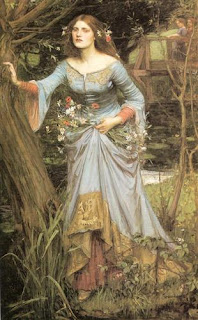
Ophelia (1910)
John William Waterhouse
source Wikiart
We now have Ophelia reading a book, once again bringing the theme of words again into the play.

While Hamlet’s “lunacy” has appeared rather benign and sometimes silly, Claudius has come to the conclusion that it is dangerous, evidence that he believes that it is cloaking another intent.   While (in the last scene) Hamlet is preparing to set a trap for Claudius, Claudius now sets a trap for Hamlet by spying on him.  Part of Claudius’ suspicions of Hamlet, appear to stem from his own guilt.  When Polonius remarks that people who appear good can act badly, Claudius agonizes:

                       Oh, ‘tis too true!
How smart a lash that speech doth give my conscience!
The harlot’s cheek, beautied with plastering art,
Is not more ugly to the thing that helps it
Than is my deed to my most painted word.
O heavy burden!”

So both Hamlet and Claudius have set or are setting traps, and both have guilt and are struggling with their consciences.

Hamlet’s “To Be” speech is electrifying.  The fear of death keeps people in a life of drudgery and toil and prevents him from commiting suicide.  The unknown is more fearful than the known.  Again he mentions conscience.

Hamlet’s words to Ophelia seem severe and hurtful, but one must remember that Hamlet is so encased in his troubles that Ophelia, being a woman, is, in effect, Gertrude to him, and he has transposed all his mother's perceived wicked qualities to this young woman. 

Hamlet and Ophelia (1883)
Mikhail Vrubel
source Wikiart


Tuesday, 27 October 2015

Hamlet ~~ Act II Scene II


Poster for the premiere of Hamlet
at the Paris Opéra, 1868
source Wikipedia

Hamlet  ~  Act II  Scene II


Claudius summons Hamlet’s two good friends, Rosencrantz and Guildenstern, to attempt to find out what ails the young prince.  They promise to obey the king’s wishes and set off to complete their charge, whereupon Polonius enters, claiming to have discovered Hamlet’s ailment, but first Claudius must hear what the ambassador to Norway, newly returned, has to say.  The king of Norway, upon learning that Fortinbras intended to attack Denmark, has had him arrested.  When Fortinbras repented, the king gave him money and has employed his soldiers to attack Poland, asking for passage through Denmark for this task, and promising them protection.  Claudius is pleased with the news.

With much prevaricating. Polonius announces that Hamlet is mad with love for Ophelia.  He suggests setting up a meeting between them, while he and Gertrude hide behind an arras to see if his supposition is valid.  When Hamlet enters the room he asks leave to speak with him alone, which the king and queen grant.  He then tries to draw Hamlet into a conversation, his replies of which appear to be madness to Polonius, but are they?  Some of his comments, while on one hand are strange, on the other are quite pointed, and even Polonius appears to pick up that 'though this be madness, yet there is method in 't.'

Rosencrantz and Guildenstern appear and Polonius directs them towards Hamlet, who questions why they have been sent to a prison such as Denmark. Before they respond, there is a little talk about dreams and ambitions, and beggars and monarchs, then they profess they are only there to see Hamlet. The prince seems as if he judges their answer suspect and quizzes them if their presence might not have been encouraged by another party.  He finally persuades them to be sincere, and it is Hamlet who says that he will relate who has engaged their services and why, but then he digresses with descriptions of the heaviness hanging over him and his disinterest in men. Rosencrantz hopes that is not the case because he has brought a troupe of players with him to amuse the prince.  Hamlet is cheered and seems particularly interested in their aptitude and how big an audience they will draw. He banters with Polonius, using his crazy-fashion again, yet within this section utters a very telling statement:

"I am but mad north-north-west.  When the wind is southerly,
I know a hawk from a handsaw."

He banters with the first player, showing a surprising propensity for acting and invention, and a first rate memory.  Before the player leaves, Hamlet ensures that the troupe will be able to perform a particular play and deliver lines that he himself will write.  Yet when everyone leaves, Hamlet returns to his brooding introspection.  He is disturbed that the actor can arouse passionate feeling from nothing but a play, yet he has vehement emotions swirling within him, but has not acted upon them.  He muses that people have been emotionally affected by performances, so much so that they have been moved to confess to crimes.  He plots to have the players perform a murder like his father's and observe Claudius' reaction.

"............    The play's the thing
Wherein I'll catch the conscience of the king."


Children acting the play scene from Hamlet (1862)
Charles Hunt
source Wikimedia Commons


Thoughts:


Good heavens!  Would you trust a country who has recently been prepared to attack you, to deploy their armies throughout your nation, based on good faith?!  Is this an indication that Claudius is completely foolish or is there more to this than first seems?

Ah, a touch of humour is added to the play!  Polonius, while stressing the importance of getting to the point, does anything but, and his prevaricating and excessive discourse becomes annoying not only to the king and queen, but to the reader as well.  As Hamlet later calls him, he certainly appears a 'tedious old fool.'

The part about Denmark being a prison was rather telling.  Laertes had already emphasized Hamlet's responsibility to his country, given his position, and now he also has a perhaps deeper responsibility to the ghost of his father. No matter how he might want to escape these problems, both political and filial duty prevent him, and he is indeed a prisoner.

While Hamlet's actions may appear mad to those around him, reading behind his words, so far he appears quite sane.  His reason is powerful as he uses it to plot revenge, while confounding his friends and family.  His madness is a smokescreen to hide his true intentions.  Yet in this scene we see another emotion from Hamlet.  Guilt.  He has been commanded by the ghost of his father, and perhaps also his own conscience, to enact revenge, but he has not been able to bring himself to act.  Will this new sensation destabilize him, or make him more focused on his task?

Hamlet & Polonius
Eugene Delacroix


Monday, 26 October 2015

The Canterbury Tales ~~ The Nun's Priest's Tale & Epilogue


(Note:  The Word of the Knight to the Host at the end of The Monk's Tale in my edition [the Penguin Classics edition] in other editions is counted as the Prologue to this tale, the Nun's Priest's Tale.)

The Nun's Priest's Tale


An old widowed woman lived very meagerly with her three daughters, three sows, three cows, a sheep called Molly and a very fancy, and elegant rooster, Chanticleer.  This burnished cock lived with his lady, Lady Pertelote, and their song was a delight to the ear.  Yet one dawn, Chanticleer had an horrific nightmare, a prophecy of sorts, in that a red beast was hunting him, intending his death.  Upon hearing about the dream, Pertelote disparaged Chanticleer, calling into question his roosterly-fortitude.  How could she love such a lily-livered scaredy-cat?  Everyone knew that dreams were not to be depended on, including the wise Cato.  The nightmare must have come from vapours and her husband need only take a laxative to purge himself of them. Chanticleer countermanded her argument by providing several examples of dreams which came to fruition.

Rooster (1900)
Ivan Bilibin
source Wikiart
Then one May day, Chanticleer with his seven wives, was busy praising the sun, but Fate had a surprise in store for him.  A wily fox had managed to find his way into the barnyard.  Upon spotting the sly predator, the rooster felt as if he should flee, but the fox worked his wiles, praising the majestic voice of Chanticleer with honeyed words of deceit.  His ego inflated past sense, Chanticleer did not notice the fox move, and he was soon in his jaws as the fox leapt away with him.  Alerted by the noise, the whole household saw the fox with his prey and engaged in pursuit, but all looked bleak for our rooster until a clever thought came into his head.  He convinced the fox to yell insults at his pursuers and gloat upon his victory, whereupon when the fox opened his mouth to do so, Chanticleer escaped his clutches by flying up to the tree-tops.  The fox tried to convince him to come down again and they jeered at each other, but Chanticleer wisely stayed put.

"St. Paul himself, a saint of great discerning
Says that all things are written for our learning;
So take the grain and let the chaff be still.
And, gracious Father, if it be thy will
As saith my Saviour, make us all good men,
and brings us to his heavenly bliss.
                                        Amen."

Middle English:

For Seint Paul seith that al that writen is,
To oure doctrine it is ywrite, ywis;
Taketh the fruyt, and lat the chaf be stille.
Now, goode God, if that it be thy wille,
As seith my lord, so make us alle goode men,
And brynge us to his heighe blisse! Amen.


A mid-19th century Victorian stained glass window
source Wikipedia


The Host commends the Priest for his merry tale and likens him to a grand cock with many pretty hens if only he'd been secular, pointing out his many manly features.  He then turns to the next pilgrim, although we are not told who it is.

Scholar are not quite certain whether to interpret this tale as a parody or an allegory, once again highlighting Chaucer's merry aptitude for confusion.  Is it supposed to be funny or serious or both, and why can no one tell which?  It's also the only one of the tales to allude to a 14th century event, the Peasants' Rebellion of 1381, when it refers to Jack Straw, it's notorious leader.