Thursday, 7 April 2016

Born Again by Charles W. Colson

My WEM Biographies Project has been thrown out of order by my library who doesn't carry most of the other titles, so I've been forced to wait for them on inter-library loans.  Which means that I have no idea when they are going to arrive or which is going to arrive first.  After two months, the first book has arrived, Born Again by Charles W. Colson.

Colson occupied a position high-up in the United States government, serving as Special Counsel to Richard Nixon during Nixon's years in the presidency.  Named as one of the Watergate Seven, he was tried and sentenced to one to three years in prison.  His autobiography is a story of his rise and fall, and finally his rise again to a higher calling.

Colson briefly covers his early life as a U.S. Marine, his education, and the opening of his law practice in Massachusetts, then quickly moves to his initiation into politics and his service to President Nixon.  Called Nixon's "Hatchet Man", he was quoted as saying that he'd walk over his own grandmother to get the job done.  Yet at the time, Colson saw these qualities as necessary in the political world.  Using an "ends justifies the means" mentality, he felt that he was helping the president build a world of peace and safety.  Ironically, with those altruistic sentiments, came an anger and intolerance against anyone with different opinions:

"..... a Holy War was declared against the enemy --- those who opposed the noble goals we sought of peace and stability in the world.  They who differed with us, whatever their motives, must be vanquished.  The seeds of destruction were by now already sown --- not in them but in us."

Colson shows how good intentions, however noble, can be corrupted without the values of a higher authority than man himself.

Watergate Complex
source Wikipedia

With Colson assisting in Nixon's re-election yet not planning to stay on into the second administration, on June 17, 1972, a security guard discovered five men inside the National Democratic Commitee offices in the Watergate Complex.  As the story leaked, a bugging system had been installed in the offices by Nixon's men. Although Colson had nothing to do with this "scandal", being Nixon's henchman, he immediately began to take the heat.

Yet even before Watergate broke, Colson was having a crisis of conscience over his behaviour and the accepted unscrupulous behaviour of others in this political machine. His mind became opened to the immorality rampant in Washington and he strove to reconcile it with his moral principles.  When Watergate hit, his turmoil increased:

"In the whole sordid Watergate struggle, the Weicker episode (a senator who told him he wanted to break his nose) for me was the most unpleasant; being falsely accused before millions on national TV, then coming almost to blows with a United States senator.  I was used to playing as rough as the next guy, but Watergate was creating a madness I had never witnessed in twenty years in Washington, reducing political morality to the level of bayonet warfare ......... The feeling of empitness was back as well, the questions about myself, my purpose, what my life was all about .... " (p.118)

Curiously at this time, he began to meet Christians, including Doe Coe, Harold Hughes, Graham B. Purcell, Jr. and Al Quie, congressmen and senators who were part of the political machine, understood the mess but managed to live with integrity and morality within the turmoil.  These "brothers" were both Republican and Democrat, and yet party polarity meant nothing to them, as their bond was formed based on the common love of Christ.

In a nationally syndicated column, reporter Nick Thimmesch wrote of the growing prayer meetings:
 " ..... spurred by Watergate ..... They meet in each other's homes ..... they meet at Pryer Breakfasts, they converse on the phone ..... a Brotherhood in belief .... there are many here and more are forming ..... I am not about to say that virtue and nobility are about to envelop the nation's Capital --- this is a tough, hard town.  But Watergate has created a great introspection, especially about personal values and this underground prayer movement can provide some peace, and a better sense of direction to many afflicted with spiritual malaise... " (p. 204)

Nixon announces release of edited transcripts of
the Watergate tapes
source Wikipedia

While Colson stuck by the president, professing both of their innocence, with the release of Watergate transcripts, it became apparent that the president knew more than Colson suspected.  While Colson had been urging exposure for those involved, behind closed doors Nixon was stonewalling the investigators.  Among other regrets, Colson felt that the transcripts showed Nixon at his worst, instead of the complex man he was, a man who was passionate about his country, altruistic, and industrious, yet with faults that were all too common within political culture.  The transcripts, however, appeared to vindicate Colson.  Even the prosecutor finally acknowledged to the press:

"Colson's alleged roles in the cover-up and burglary would have been more difficult to prove than those of the other alleged conspirators ...... because this man was outside the main stream of the overt acts."  (p. 260)

Finally, with Colson's indictment, on his lawyer's advice he pleaded not-guilty, but took the fifth amendment, yet this plea did not assuage Colson's conscience nor align with his new-found Christian belief.  While he was not party to the Watergate affair, he was complicit in a break-in 10 months earlier, a break-in of a psychiatrist's office to search for information on Daniel Ellsberg, a military analyst,  planning to use the data as a smear tactic against him; Ellsberg was suspected of leaking Pentagon Papers to the New York Times.  Burdened with his part in this particular campaign, Colson, with the support and prayer of his new friends, decided to tell the truth.  It was a shocking decision from a man who, if he'd kept silent, would likely have been acquitted and could have gone on to live a very comfortable existence.  However, Colson had been reading Dietrich Bonhoeffer's The Cost of Discipleship and was convicted by these words:

"The first step which follows Christ's call cuts the disciple off from his previous existence.  The call to follow at once produces a new situation.  To stay in the old situation makes discipleship impossible." (p. 242)

Colson's resolution, not only sent his lawyers into fits but came with a cost.  However, the new life he discovered held infinity more success and contentment and freedom than his old life had supplied.

On June 21, 1974, Colson was sentenced to one to three years in prison and a $5,000 fine.

White House Special Counsel Chuck Colson
source Wikipedia

Sent originally to Fort Holabird prison, where he was needed as a witness, Colson spent most of his sentence at Maxwell Correctional Facility in Alabama.  Initially, while the experience was foreign and unsettling, while reading his Bible, Colson noticed a beauty and wonder in the words, understanding the Trinity in a deeper sense and with a personal message woven within it:

"Just as God felt necessary to become man to help His children, could it be that I had to become a prisoner the better to understand suffering and deprivations?  If God chose to come to earth to know us better as brothers, then maybe God's plan for me was to be in prison as a sinner, and to know men there as one of them.  Could I ever understand the horrors of prison life by visiting a prison?  The voice inside of me answered: Of course not.  No one could understand this life without being a part of it, feeling the anxieties, knowing the helplessness, living in desolation.  On a tiny scale, it was the lesson of Jesus coming to us."

Colson began to see his incarceration as an opportunity to reach out and help people. He began immediately to connect with the inmates, meeting with some to pray, helping others with their letters to gain parole, and even helping smuggle dye into the facility to dye some coats prison-brown so the prisoners would not have to freeze during the winter (Later, he regretted this breaking of the rules, an evidence of his old habit of manipulating situations).  Colson had true empathy for these men, many some of who were imprisoned due to mischance, or harsh sentencing.  Through his love and caring for the prisoners around him, he began to change some of their outlooks and behaviour, and when he was released from prison seven months later, there were many whom he'd call "friend".

Colson on one of his prison visits
photo courtesy of martyangelo.com


While the book ends with Colson's release, his interactions with inmates didn't end there.  Having an enormous heart for their plight and the struggles they faced, he began Prison Fellowship, an organization that grew to become the nation's largest, helping both prisoners and their families.  In the epilogue of the book based on a study done at the University of Pennsylvannia, Colson reveals that when comparing the inmates who have gone through his program with the general prison populous, only 8% of the his prisoners reoffended within 2 years, compared with 20% of prisoners from the control group and 50% nationwide.  With these very impressive statistics, I found some online controversy about them, complaints that of the 177 people in Colson's study group, that only the 75 people who graduated were used for the study, skewing the figures to his advantage.  These complaints appear inconsistent with the purpose of the study.  The intent of the study was to show the re-offending figures of Prison Fellowship graduates compared to the standard prisoner.  To use prisoners who didn't fully complete the program would be senseless and not within the study's parameters.  The report as is, does show that if a prisoner stays in the Prison Fellowship program and completes it, he has much better chance of returning to society, becoming a useful member of it, and living a fulfilling life.

Some reviews (and even the introduction to Colson's book) claim that the main focus of the book is Colson's conversion and not the Watergate scandal, which isn't quite accurate.  While I won't argue with the verb "focus," practically most of the book relates Colson's political career, and with perhaps ¼ covering the period of his incarceration, the book ending right after his release.  However, I do think that the back-story is imperative to build and explain his journey from a cut-throat politician to a committed Christian with not only a love for his fellow man, but a desire to put that love in action to better the lives of others.


Tuesday, 5 April 2016

Metamorphoses ~ Book XIV


Book XIV


Glaucus, Circe, Scylla / The Cercopes / The Sibyl / Achaemenides / Aeolus, Ulysses, Circe / Picus & Canens / Diomedes / The Apulian Shepherd / Aeneas' Ships / Ardea / Aeneas / Vertumnus & Pomona / Iphis & Anaxarete / Vertumnus & Pomona / The Fountain of Janus / Romulus / Hersilia


Passing the Cyclop's fields, Messina, and that dangerous strait that separates Ausonia and Sicily, Glaucus streaks through the Tyrrhenian sea until he reaches Circe's palace. He tells of her of his woe and the fleet foot of Scylla who spurs his advances, but the goddess is enraged that he can only love Scylla and not her.  Chanting infernal spells of Hecate, she heads for Rhegium across from Messina, polluting Scylla's favourite pool with noxious poisons.  As soon as the girl immerses herself, she sees snarling barking dogs in the water.  Leaping up and running, she is astonished that she cannot escape them, finally realizing that they are part of her lower quarters.  Glaucus flees in anguish but Scylla remains, and it is she who snatched up Ulysses' men for revenge on Circe (see The Odyssey Book XII).  She would have swallowed all the ships that passed if she hadn't been changed into a rock, but even then, sailors fear her presence.

Tilla Durieux als Circe (1913)
Franz von Stuck
source Wikimedia Commons

When the Trojan ships pass Scylla and Charybdis, the wind pushes them back to the Libyan coast where a woman from Sidon (Dido) welcomes Aeneas.  Unable to bear his departure, when he leaves she falls on her sword, but Aeneas continues on, visiting Acestes at Eryx, passing the rocks called the Sirens, Achelous' daughters.  Having lost his pilot, Palinurus, he sails along barren Pythecusae (an island off the coast of Naples) where a pack of scoundrels called the Cercopes live.  They were so dishonest that the father of the gods transformed them into monkeys and their words into chatter.

Aeneas sails past Parthenope and turns westward, finding the tomb of the trumpeter Misenus.  Upon entering the Sibyl's grotto, he requests to cross Avernus and speak with his father's shade.  The Sibyl reveals that because of his great virtue, she can assist him and orders him to pluck a golden bough in the forest of Persephone.  He is shown Anchises' shade and the laws of the underworld.  Grateful, Aeneas thanks the Sibyl and offers to build her a shine but she refuses.  She could have been a goddess but she submitted to Apollo's love and afterwards, she asked him for long life, forgetting to also ask for youth.  Thus, she will become a shrivelled form and suffer the frailties of old age.  Aeneas then sails to a shore, naming it Caieta after his old nurse.

Aeneas and the Sibyl (c. 1800)
Unknown
source Wikimedia Commons


Macareus of Neritus, companion of Ulysses, had long been living on this shore and is astounded to see his friend, Achaemenides, still alive and among the Trojans.   He wants to know why his friend, a Greek, is sailing in a Trojan boat.  Achaemenides reveals that he loves Aeneas as a father because it was he who prevented him from becoming food for the Cyclops (see The Odyssey Book IX).  He saw Ulysses and his comrades sail away from the island of the Cyclops, and he would have shouted but was terrified of discovery. Watching the Cyclops cursing the Greeks, he remembered how he'd eaten his friends, and he hid, eating acorns, leaves and grass.  He finally saw a Trojan ship that took him away.  Now he wishes to hear Macareus' story.

Macareus tells of his voyage with Ulysses and how they received a gift from king Aeolus of a sack of wind (see The Odyssey Book X).  Finally, they reached Ithaca, but greedy and curious, they released the tie and the wind rushed out, blowing them all the way back to where they'd started.  They reached the city of the Laestrygonians surrounded by the walls of Lamus, and Ulysses sent his men to reconnoitre but the inhabitants attacked them and then threw rocks at his ships from above.  Only the ship of Ulysses escaped.  Next, they landed at the isle of Circe (see The Odyssey Book X), against whom Macareus delivers a ominous warning.  They drew lots to see who would call at her door and were met by a number of beasts, but though her appearance was appealing, she slipped a drug into their drinks, transforming the men into pigs. Eurylochus escaped to warn Ulysses and although Circe attempted to charm him, he drew his sword, forcing her to change the "pigs" into men again, even as he agreed to be her husband.

Circe (1889)
Wright Barker
source Wikimedia Commons

For a year they stayed in the land of Circe.  One day her nymph showed him a snow-white marble statue of a man with a woodpecker formed on his head.  The nymph informed him that the effigy was Picus, son of Saturn.  He had been sought by all the nymphs and dryads, but he had love for only one, Canens, and she became his bride.  As beautiful as she was, she could also move the woods with her songs.  Seeing Picus hunting one day, Circe lured him into the woods and confessed her love for him but he spurned her advances.  In anger, she turned him into a woodpecker, and as his men attempted to find him, accusing her of his disappearance, she transformed them into beasts. Canens, in mournful despair, wandered searching for her husband, and finally, worn out, vanished into thin air.  The story finished, Macareus tells his listener that they prepared to leave Circe's island, but the witch warned them of treacherous dangers, so he decided to remain behind.

Nymph (1929)
Gaston Bussière
source Wikipedia Commons


They leave the ashes of Aeneas' nurse, Caieta, on a tomb, then set sail, next landing in Latium where 'the Tiber's waters pour their yellow silt into the sea'.  He is greeted by Latinus, son of Faunus, and Aeneas takes a bride, Lavinia, the daughter of Latinus. Turnus is enraged because Lavinia had been promised to him!  The battle is furious with Aeneas receiving help from Evander, but Turnus, through his man Venulus, receives a refusal of assistance from Diomedes.  Diomedes had earlier arrived at Iapygia, founded a great city and married Daunus' daughter.  His refusal stemmed from the weakness of his troops, as they had been greatly reduced.  When Ajax had raped the priestess, Cassandra, at the end of the Trojan War, Minerva in her rage cursed the Greeks and their journeys home were fraught with peril.  Diomedes and his men were shipwrecked and Acmon scorned the goddess, causing her to turn him and almost all the rest of Diomedes' men into a flock of birds.

Venulus continued on, passing the Peucetians and arriving in Messapians where he saw great caves.  Long ago, it had been the home of Pan, and then nymphs, but an Apulian shepherd had startled them, and as he mocked their choral dance, was changed into an olive tree.

An Olive Tree in the Garden of Gethsemane (1882)
Vasily Polenov
source Wikiart

When Turnus learns no help from Diomedes will be forthcoming, he attacks Aeneas, reaching his ships and putting torches to them.  But Cybele recalls the timbers of Aeneas' ships had come from her pine trees, sacred wood, and cursing Turnus, she promises their salvation.  The Mother goddess snaps their hawsers, then tilts them into the sea and they become sea-green Naiads.

There was hope that the Rutulians, seeing such power, would cease fighting but it was not to be.  Both sides, contended still, driven by courage more than the gods, and instead of brides, or dowry, or land, they fought for glory.  However Turnus fell and so did his town of Ardea; it was burned to the ground and from the ashes, a heron flew into the sky.

Ascanius, son of Aeneas, and now named Iulus (hmmm ..... sounds very similar to "Julius") has grown to manhood and his father reaches his end.  Venus petitions Jove to grant her favourite a divinity.  When even Juno agrees, Venus flies with her harnessed doves to ensure the river-god carries the mortal parts of Aeneas to the sea, where she anoints him with ambrosia and declares him the god, Indiges.

The Purification of Aeneas in the River Numicus (1725)
Pier Leone Ghezzi
source ArtUK

Iulus is now the king of Alba.  Next in line came Silvius, then his son, Latinus, then Alba and Epytus, his son.  Capis and Capetus followed, then Tibernius who had sons Remulus and Acrotas.  Remulus was struck by lightening, so Acrotas passed the title to Aventinus and finally Proca.  The next story about Pomona, took place in the days of this king.

Pomona was a nymph who loved all gardens and orchards, but spurned all men.  The god, Vertumnus, brought her gifts but to no avail, so he craftily disguised himself as an old woman, bestowed forceful flattery upon her and told her the following story.

In Cyprus, young Iphis loved Anaxarete, but while she was from a noble family, his birth was very humble.  Continuously, he wooed her and left her gifts wet with his tears, yet she was harsh and disdainful towards him.  When his torment became long, he took a rope and hung himself from her doorway.  Wailing servants returned his corpse to his widowed mother, who was heartbroken.  As his body passed Anaxarete's house on the way to its pyre, she leaned out the window, and when her eyes rested on Iphis, she tried to step back but couldn't.  Her body was held fast by the stone that began in her heart and she metamorphosed into a stone statue.  Vertumnus cautioned Pomona to remember this tale, urging her to wed the one who loves her.


Vertumnus & Pomona (1617-19)
Peter Paul Rubens
source Wikipedia

Pomona was unresponsive to Vertumnus' pleas, but when he shed his disguise, revealing himself as a god, and prepared to take her by force, she decided that she liked him more than a little and gave herself to him.

The above story took place during the rule of Procus in Ausonia, then Numitor should have had the crown, but his false brother usurped it, his name, Aumalius.  But Numitor's grandsons came to his aid, Romulus and Remus, and Rome was founded.  Tatius and the Sabines waged war upon the city, the treacherous Tarpeia showing them the secret route to the citadel.  They reached the gate and dispatched the sleeping sentinels, however Juno had loosed a bar to allow the gate to be opened.  Venus wished to undo her work but one god cannot undo the work of another so instead, she had the Naiads of Ausonia rush the waters of the fountain of Janus downstream, igniting the stream with burning sulfur.  The Sabines could not pass easily and the Romans had time to arm themselves. There was much slaughter before peace was declared and Tatius shared the crown.

Finding of Romulus and Remus (1720-40)
Andrea Lucatelli (credited)
source Wikimedia Commons


When Tatius dies, Romulus has sole rule and treats both the Romans and Sabines equally.  It is time for the death of Romulus and Mars asks for him to be deified. Racing down in his chariot, Mars seizes his son, and as his mortal parts dissolve, he becomes the god, Quirinius.

The wife of Romulus, Hersilia, weeps endlessly for her husband, so Juno orders Iris to fetch the woman.  She follows Iris to the Palantine hills where a star descends, lighting Hersilia's hair and she ascends with the star, becoming the goddess Hora, who now walks with her husband.

❇ ❇ ❇ ❇ ❇ ❇ ❇ ❇ ❇ ❇ ❇ ❇ ❇ ❇ ❇ ❇ ❇ ❇ ❇

There are interesting parallels that Ovid provides us:  both Odysseus (Ulysses) and Aeneas have contact with Polyphemus, Scylla, Aeolus, the Sirens and Circe.

The verse gets less fluid towards the end of this book, with lots of changes in time and a very quick catalogue of Latin kings.  I must say I've enjoyed the Greek stories more, but it's been fun to revisit some of Odysseus' journeys through Aeneas.


Metamorphoses:

Scylla's lower body  ❥  snarling dogs
Scylla  ❥  rock
Cercopes  ❥  monkeys
Ulysses' men  ❥  pigs
Picus  ❥  woodpecker
Picus' men  ❥  beasts
Canens  ❥  thin air
Acmon & Diomedes' men  ❥ swan-like birds
Apulian shepherd  ❥  olive tree
Trojan ships  ❥  sea-green Naiads
Ardea (town)  ❥  heron
Aeneas  ❥  Indiges (god)
Vertumnus (god)  ❥  Vertumnus (old woman)
Anaxarete  ❥  stone statue
Vertumnus (old woman)  ❥  Vertumnus (god)
Romulus  ❥  Quirinius (god)
Hersilia  ❥  Hora (goddess)


Sunday, 3 April 2016

Villette by Charlotte Brönte

"My godmother lived in a handsome house in the clean and ancient town of Bretton."

What on earth have I just read?  This book simply cannot be written by the same author who wrote Jane Eyre!  The mind rebels!  The heart rebels!  It cannot be!  Am I sounding very dramatic and flourishing and vocal?  That's because I've spent 572 pages being lulled catatonic.  What happened .....??

Brönte begins with introducing the reader to Lucy Snowe, an unassuming educated young woman, who is left alone after the death of her family, with only her godmother, Mrs. Bretton as a familiar contact.  In the house of her godmother, she knows her son, Graham Bretton, and on one visit meets a lodger, a little girl named Polly who is quick-witted, yet bordering on rude and displays an unusual attachment to the Bretton son.

As Lucy returns home, this story is left hanging and we follow Lucy to a job as a companion and then, at the death of her employer, Lucy decides to set out for the country of Labassecour (thought to be modelled on Belgium, where Brönte herself taught at a girl's school) to search for work.  Miraculously, she is immediately taken on as a teacher at a respectable school in the town of Villette.  Through Lucy's eyes only, we meet the headmistresses, Madame Beck; teachers at the school, in particular the fiery M. Paul Emmanuel; Polly's cousin, Ginevra; and finally an astounding secret about the local doctor, Dr. John, is discovered.  Coincidence piles up on coincidence, until one no longer puzzles but simply must move on.  Two important relationships occur in Lucy's life, yet nothing seems to truly touch her as she remains the passive and faithful narrator, except when it comes to the collision of Catholicism and Protestantism, one of which she attacks with a vitriolic vehemence and the other which she lauds as the only way to heaven.


School for Peasant's Children in Verkiai(1848)
Vasily Sadovnikov
source Wikiart

The writing meanders all over the place and the characters appear chiselled with a hacksaw.  Polly who is mean-spirited and selfish as a child, suddenly appears, not only in a completely different city but in a different country and, as a young woman, is now pleasing and thoughtful and wise.  And she has developed this warm and winning character in spite of having a father who is rather petty, obtuse and slightly vindictive. Her great love for him appears to be the only explanation as to her transformation. Characters are often described by Lucy as having certain traits and then later are bestowed with either oppositie traits, or the original ones are highly magnified in melodramatic fashion to serve authorial purposes.  The process is problematic, to say the least.

Astraea, the virgin goddess of
Innocence and Purity (1665)
Salvator Rosa
source Wikipedia
Lucy herself is our greatest conundrum. She is like a wraithful spirit who hovers over the drama in the story and participates in narration and judgement but barely with action.  Like the Greek goddess Astraea, she pronounces moral, religious and ethical judgement on each character, yet in her zeal, often appears to forget that she is on the same level as those around her.  Nevertheless, she is a complex character and while her sentences can often be harsh, we also at times sense a softening of her manner and a deeper generosity in her character.

Brönte does display some fine writing in parts of the novel and there is a peculiar weaving of a wild, melodramatic narrative into a character who is quiet, aloof, reserved, and very nearly lifeless.  Brönte also employs contrasting themes but I would have enjoyed them more if I felt that they came from superior writing aptitude instead of displayed prejudices.  I also was irritated with her penchant to play with the reader.  She seemed to be saying, "oh, so you'd like to see this scenario play out?  Well, too bad, I'm deliberately going to give you this."  Quite frankly, I finished feeling rather offended, as if someone had just been rude or discourteous.  An excuse for her approach may be found in the successive deaths of three members of her family within eight short months, five years before Villette was published, and there is some suggestion that Brönte was struggling with depression. With this fact in mind, I honestly tried to stick with this novel and find some sort of redeeming feature, but the inconsistencies and coincidences were simply too insurmountable, and the meek yet God-like character of Lucy too unpalatable.  Certain reviews claim that this book is a psychological masterpiece, and as I said, Brönte certainly seems to play with psychological aspects of both the characters and the readers' perceptions of them.  Yet this experiment is conducted in an unnatural way, one that is ripe with preposterous manipulations and improbable fluctuations in both personalities and circumstances.  I was psychologically exhausted after finishing the novel, not for its fine crafting, but in an effort to grasp its implausibilities.  If that brand of psychology is admirable, I would rather treasure the simplicities of Jane Eyre.

Woman Reading (1894)
Henri Matisse
source Wikiart

I must say the only benefit gained from reading Villette is perhaps the personal insight it gives into Wuthering Heights.  The raw, wild, startling prose of the latter, while not necessarily obvious in the former, exists in echoes, while the ghostly apparition and the darkness in the souls of men stand out in stark relief.  Villette was an unsettling novel certainly, but more importantly it was unsatisfying, and I was left with a sense of emptiness and time wasted.  Fortunately there are rumours of read-along of Jane Eyre coming up at the end of May, hosted by Hamlette at The Edge of the Precipice.  Thank heavens!  I will be able to cleanse my palate with one of my all-time favourite novels and hopefully regain some of the deep respect I had for its author.


Further Reading:


Saturday, 2 April 2016

Poetry Month Tag


The Poetry Month celebration has begun at The Edge of the Precipice, and Hamlette has posted a tag with a few questions to answer.  Poetry and I aren't close friends yet, but we'll see how I do .....  Fortunately the first questions is easy!


What are some poems you like?

The Lady of Shallot by Alfred Lord Tennyson
The Highwayman by Alfred Noyes
Annabel Lee by Edgar Allan Poe
Ode to a Nightingale by John Keats

What are some poems you dislike?

Since I’m a rank amateur when it comes to poetry, I'm trying to concentrate on poems which I think I’ll enjoy. I haven’t come across any I particularly dislike as of yet.  As for poets whom I’m hesitant to read because I think that I might not like their works, I can guess perhaps Lord Byron and William Blake.  But I could read them and love them for all I know!  

Are there any poets whose work you especially enjoy?  If so, who are they?

I’m very excited to read more Keats.  His ability with words and images is magnificent!  Then I’d also like to read more of Tennyson, Hilaire Belloc, and Oscar Wilde.  Curious list, isn't it? :-)

Do you write poetry?

I used to write a little long ago when I was in high school.  I remember that I wrote a haiku that my teacher loved, so I’m going to try to find it and post it.

Have you ever memorized a poem?

Yes!  A few:  Jabberwocky by Lewis Carroll,  My Shadow by Robert Louis Stevenson, Celery by Ogden Nash,  and Ooey Gooey by Unknown.

Do you prefer poetry that rhymes and had a strict meter, or free verse?  Or do you like both?

I don’t enjoy rhyming for the sake of rhyming, but with poems such as The Canterbury Tales, the rhyming forms part of the tone of the stories and it’s wonderful!  Free verse has been less enjoyable for me, but again, I haven’t had much experience with it and my opinion could certainly change.

Do you have any particular poetry movements you're fond of?  (Beat poets, Romanticism, Fireside poets, etc?)(If you haven't got any idea what I'm talking about, that's fine!  You can check out this list for more info, if you want to.)

I have no idea what Hamlette is talking about!  Just kidding. ;-)   I actually enjoy epic poems best, such as The Iliad, The Odyssey, Beowulf, etc.  As for eras, I think I’d like the Romantics, but again, I’m not sure. 


For my first poem of the month, I'm going to read Narnian Suite by C.S. Lewis because I'd never heard of it before and surprisingly it seems very Tolkien-ish.  Since they were part of the Inklings, a group that met together and read their writings to each other, it's perhaps expected that certain styles and tones of writing, might have rubbed off on each other.


Wednesday, 30 March 2016

The Oresteia ~ The Libation Bearers by Aeschylus

The Return of Orestes (1785)
Anton von Maron
source Wikimedia Commons


The Libation Bearers by Aeschylus


"Hermes, lord of the dead, who watch over the powers
of my fathers, be my saviour and stand by my claim.
Here is my own soil that I walk.  I have come home;
and by this mounded gravebank I invoke my sire
to hear, to listen ....."

Mercury (Hermes) (1636-38)
Peter Paul Rubens
source Wikimedia Commons
The play opens with Orestes standing at the tomb of Agamemnon, with a request to Hermes (or "Cthonic Hermes" who acts as a messenger between the Olympian gods and the Underworld) for favour and for the ear of his father, to bring his spirit back into play. Sadly, in the only surviving manuscript of The Libation Bearers brought to Florence in the 15th century, the opening speech is damaged and there are number of missing lines, the number of which can only be guessed (an estimate is 80 lines).  However, other lines survive in works of other authors:  the first five lines are written in Aristophanes' play, The Frogs, and other lines can be found in the commentaries of other authors, however, it is expected that most of the explanatory prologue has been lost.

As Orestes lays a lock of his hair on the tomb to honour his dead father, a Chorus of women, dressed all in black, hurry towards the grave.  As they approach, Orestes and his companion, Pylades, hide themselves and he recognizes his sister, Electra, among the mourners.

The women are captive slaves who have been sent by Clytaemestra to pour libations (liquid offerings) on Agamemnon's grave in response to a nightmare which has disturbed her sleep.  The dead king rages through the queen's dreams and she will placate his spirit if she can, but the Chorus sings of the impossibility.  The crime committed far exceeds any reparation.

Lacrhrymae
Frederic Leighton
source Wikiart
Electra's conflict is truly pitiable.  How can she complete the task in true principle?  Both her father's body and memory have been disgraced, and furthermore the acts were perpetrated by her own mother.  How can she give her father prayers from his own murderer?  Should she simply pour the libations into the ground?  In a fascinating exchange, the Chorus acts as a teacher or mentor, instructing Electra in almost a Socratic way, encouraging her to pray for retribution and the return of Orestes.  First praying to Hermes, Electra's prayer then moves to her father, asking for vengeance with a glimmer of hope that good will come out of it, almost like her father's wish in Agamemnon.  Can good come out of evil?  We shall see ..............

Reaching the tomb, Electra is astonished to discover the lock of hair, then she finds footprints, and finally Orestes comes out of concealment. However, his presence is met with doubt by his sister, yet after convincing her of his identity, she gives him all her familial love.  After praying to Zeus, Orestes recounts the oracle at Delphi and his order of vengeance, however he admits that even if Apollo would not persuade him to revenge, his own personal desires would ensure the act, dismissing both Clytaemestra and Aegisthus as "women".

As Orestes and Electra exchange prayers, mostly to their father, Orestes' resolve becomes more driven by personal desire than duty.  He then learns of Clytaemestra's dream; she birthed a snake that drew blood as it suckled, and Orestes claims the dream a portent of the coming murder of his mother.  With the chorus spurring them on to action, Orestes orders Electra to keep secret his arrival and to go inside, whereupon he leaves with Pylades to find Aegisthus and kill him.

Electra at the Tomb of Agamenon (1874)
William Blake Richmond
source Art Gallery of Ontario

As the chorus sings of parents who have murdered their children (such as Althaea & Meleager - see Metamorphoses Book VIII) and children who have killed their parents (such as Nisus and his daughter [Syclla] - see Metamorphoses Book VIII), Orestes arrives at the palace and announces to his mother the death of Orestes.  Not recognizing him, she laments the curse of the House but her regret appears mild, as the slave Cilissa later confirms when she notes there was a "smile inside her [Clytaemestra's] eyes".  Cilissa, guided by the Chorus, takes a message to Aegisthus that he needs not his bodyguard while meeting the stanger, allowing Orestes his moment of revenge.  As a servant careens through the door, calling a riddle about the living killing the dead, Clytaemestra arrives and with the courage of a man, calls for an ax. As the truth dawns, Clytaemestra's words change to the feminine, recalling her care of her son as a child.  As Orestes' resolve falters, Pylades reminds him of his duty and he finally enacts revenge for the death of his father, Agamemnon.  And in a gross re-enactment of the death of Agamemnon and Cassandra, Orestes is shown standing over the bodies of his mother and her lover, a further echo of the curse blanketing the house of Atreus.

Orestes Slaying Aegisthus & Clytemnestra (1654)
Bernardino Mei
source

Orestes' speech after the murder begins with a justification of his action, but soon the audience sees his assurance begin to break down and his mental state becomes tenuous.  Though victorious, he feels the evil in his deed.  Since Apollo had counselled his actions, he will go to him as a suppliant to beg his advice:

"I would have you know, I see not how this thing will end.
I am a charioteer whose course is wrenched outside
the track, for I am beaten, my rebellious senses 
bolt with me headlong and the fear against my heart
is ready for the singing and dance of wrath.  But while
I hold some grip still on my wits .........
.... I go an outcast wanderer from this land, and leave
behind, in life, in death, the name of what I did."

Though no one else can see them, Orestes can now see the "bloodhounds of his mother's hate." These Furies punish family member who have harmed family members, in particular, children who have abused parents.  Orestes rushes out in torment and the chorus laments, wondering what will happen to the family of Atreus.

Orestes Pursued by the Furies (1862)
William-Adolphe Bourguereau
source Wikiart

The plays of The Oresteia are astonishingly well-constructed.  All the questions of revenge and justice and murder and duty are woven with a skillful needle throughout the drama, weaving a tapestry that at times can be alternately poignant, terrifying, suspenseful or appalling.

Setting Electra, a princess of Argos, among captive slaves is very effective.  In effect, she is a slave as well, impotent in her ability to do anything about the situation. Essentially, by placing her among the women, they are made allies in their mental battle against her mother, Clytaemestra, and Aegisthus.

We've continued with the theme from Agamemnon of discordant responsibilities that bring conflicting thoughts and either paralyzed or inconsistent action.  Apollo has threatened Orestes with madness if he does not avenge his father, yet the Furies promise the same fate if he does.  His dilemma is identical to that of his father.  With blood justice comes the duty of killing but the process is always cyclical and the avenger often does not escape his own fate.  As to the limitations of this type of justice, Aeschylus makes them obvious.

De Offerstrijd Tussen Orestes en Pylades (1613)
Pieter Lastman
source Wikimedia Commons
I noticed either a "cataloguing" or a "sandwiching" of themes or issues within this play. Initially Aeschylus mentions "bright/half-dark/gloom" within three lines of the play; Electra says "... between my prayer for good and prayer for good I set this prayer for evil;" the Chorus asks for Justice (good), based on hatred in exchange for hatred, then invokes the spirit of Right (good); and throughout the play a connection is implied between the gods (heaven & Apollo), Orestes and Electra (their struggles on earth), and Hades & Agamemnon (Underworld or under earth).

There are a couple of issues in this play that readers might like to be aware of.  The scene where Clytaemestra is pleading with Orestes and bares her breast to him, is not in the original play, and merely an addition by some overexuberant revisionist fond of gratuitous additions.

I also noticed a few non-scholarly commentaries that mention that women in this play are portrayed as "weak" and their place in the home is disparaged and devalued.  In fact, in ancient Greece there were two important roles that both sexes fulfilled and, unlike modern times, there was no crossing over between the two.  The women's role in the home was considered an important one and in court if there was evidence with regard to a home in a legal case, the woman's evidence or opinion would be taken over a man's.  Interesting, isn't it?

The concluding third play of the triology is called The Eumenides.


Tuesday, 29 March 2016

Metamorphoses ~ Book XIII


Book XIII


Ajax and Achilles' Armor / Ulysses and Achilles' Armor / Ajax / The Fall of Troy / Polymestor and Polydorus / Polyxena / Polyxena & Hecuba / Hecuba, Polydorus, Polymestor / Aurora & Memnon / The Voyage of Aeneas / The Daughters of Anius / The Daughters of Orion / The Voyage of Aeneas / Galatea & Acis / Glaucus & Scylla


Ajax and Ulysses contend for the armour of the fallen hero, Achilles.  In spite of proclaiming himself a man of action and not one for florid speech, Ajax commences a rhetorical banquet, listing all his ancestors and spewing vitriol against Ulysses.  Ajax's father is Telamon, who was friend to Hercules as he destroyed Troy's walls, sailed in the ship with Jason and was born of Aecus.  In fact, he is a descendant of Jove, a honour he shares with Achilles, etc., etc.  Ulysses is nothing but a smooth talking, lily-livered, cowardly, sneaky, dishonest fraud.  Oh, and all his feats are minor.  In fact, he, Ajax, should be the winner of the armour because his own shield is so damaged with fighting, yet Ulysses' shield is so little used.  He suggests that the armour be thrown among the Trojans and whoever reclaims it, be it him or Ulysses, will be the victor.

The Quarrel Between Ajax and Odysseus (1625-30)
Leonaert Bramer
[Public Domain] source

With his renowned eloquence and gracious speech, Ulysses counters the argument of Ajax, contending that lineage should not be the judge of greatness, but instead a man's own deeds.  He disputes Ajax's deprecation of his lineage, saying that he has an equal ancestry to him, and furthermore, none of his ancestors are criminals.  As for deeds, what has Ajax really done?  However, he, on the other hand, has worked wonders, such as finding Achilles for the War, and therefore, all Achilles' feats are due to him.  He also brought about Agamemnon's change of heart with regard to the sacrifice of his daughter, and he was responsible for asking for the return of Helen.  For nine years the Trojans stayed within their walls, so open war was impossible, but while Ajax did nothing, he was busy planning objectives.  It was he who turned the troops back to war after they were going to disperse prompted by Agamemnon's dream.  His further rhetorical examples, reverse Ajax's argument with stunning guile and perception.  The Greek chieftains are so moved by Ulysses' reasoning that they award Achilles' armour to him.

Thetis Bringing Armor to Achilles (1806)
Benjamin West
source Wikimedia Commons


This decision is too much for the undefeated hero's pride and he encounters the first enemy that will be his destruction:  his own unmitigated anger.  Grabbing his blade, Ajax cries that he is the only one who can claim victory over himself, driving the shaft into his own chest.  As his blood seeps into the rich soil, up springs a purple flower, the same flower from Hyacinth's wound, with the letters, "AI-AI", echoing both of Ajax (often spelt Aias, therefore the "AI") and the lament of Hyacinth. (See Book X)

Ulysses retrieves his arrows from Lemnos, the arrows Hercules gave to Philoctetes, and brought back they haunt the skies of Troy.  The fall of Troy was swift, and with Ilium ablaze, the Trojan women embrace their gods for the last time.  They kiss the soil as they are born away, captive, and Hecuba is found at the graves of her sons.  Ulysses carries her off, clutching ashes of Hector to her bosom.

Dead Hector (1892)
Briton Riviere
source Wikiart

In Thrace lies Polymestor's magnificent palace and there he is covertly keeping Polydorus, son of Priam.  But there was gold given in payment and when the fall of Troy begins, the king slits the throat of the boy and tosses him from a cliff into the sea, to hide the body.

Agamemnon's fleet is moored along the Thracian coast when the ghost of Achilles bursts up, awesome and threatening, incensed that the Greeks would leave without honouring him.  He requests the daughter of Priam and Hecuba, Polyxena, as a sacrifice.  She dies with dignity, asking only that no rough hands touch her and that her body will be given to her suffering mother.  Every one weeps at her sacrifice.

The Sacrifice of Polyxena (1733-34)
Giovanni Battista Pittoni
source Getty Open Content


The Trojan women mourn.  Ulysses has won Hecuba but does not really want her, only accepting her because she gave birth to the great Hector.  Hecuba thought that after Achilles death he could threaten them no more, but he has proved her wrong.  Her speech is a dirge:

".... I gave birth to a funeral offering
to our destroyer.  I must have a heart 
of iron if I still resist, still live.
What am I waiting for?  Endless old age --
what can it hold in store?  O cruel gods
why do you let me live --- unless it be
that you have savd saved still other griefs for me? ...."

Priam should be glad he's gone, unable to witness the atrocity.  She cannot even give her daughter a respectable burial; the only honour Polyxena receives is her mother's tears on foreign soil.  At least, Polydorus, Hecuba's son, is sheltered by the Thracian king.  This fact is her only consolation.

Hecuba and Polyxena (c. 1814)
Merry-Joseph Blondel
source Wikimedia Commons

Hecuba moves towards the shore but suddenly sees the corpse of her son, Polydorus. The Trojan women wail in lament but Hecuba is arrested in her grief, the tragedy almost too much to bear.  As she views his fate, anger inflames her, burning to revenge.  She meets with Polymestor and promises gold for her son which he agrees to give him. False, lying Polymestor!!  Hecuba grips him and calls her Trojan women, and as she does, she digs her nails into his eyeballs and plucks his flesh.  The Thracians attack the women with stones and lances, but Hecuba attempts to catch the stones, her voice transforming into barks and howls and even the gods admit that Hecuba did not deserve such sorrow.

Hecuba (c. 18th century)
Guiseppe Crespi
source Wikimedia Commons


Aurora did not lament the Trojans' demise as expected because she was devastated by the death of her son Memnon at the hands of Achilles.  She pleads with Jove for a gift for the honour of her son and from his pyre, flames and ashes soar high then from it a bird ascends, then many.  After circling the pyre three times, they split into two flocks and begin to battle, falling into the ashes of Memnon as an offering.  They do this every time the sun rises but even to this day, Aurora mourns her son with her tears.

Aurora (1614)
Guido Reni
source Wikiart

Even though Troy was destroyed, part of it survived in the figure of Aeneas, hence the voyage of Aeneas begins.  Fleeing his city with his old father, Anchises, his son, Ascanius, and sacred images, he sails first to Thrace, then to Delos.  The kind, Anius, welcomes Aeneas, and it was here that the two tree-trunks opened and Latona gave birth to her twins.  (See Book VI)

Aeneas and his Father Fleeing Troy (c. 1635)
Simon Vouet
source Wikimedia Commons

Aeneas asks if he saw a son and four daughters of Anius when he last visited his city and Anius tells a tale of woe.  His son, Andros, is king of an island that bears his name, but Bacchus gave to his daughters the power to turn anything they touched into wheat, wine, or oil.  Realizing their value, Agamemnon dragged off the girls, to use them to feed the Grecian fleet.  Two daughters escaped to Euboea, and two to Andros, but their brother, fearing war, relinquished them to their fate.  About to be chained, the two girls lifted their arms in plea to Bacchus and were turned into snow-white doves.


At daybreak, the Trojans visit the oracle which tells them to seek out their "ancient mother" --- their land of origin.  Anius sees them off with gifts, and an engraved cup he brings tells its own story.  The seven gated city of Thebes was in a disasterous state with fires and pyres and wailing women, bare trees, stony fields and a mighty funeral pyre where Orion's daughters sacrificed themselves to save the people from the plague.  Out of their virgin ashes rose the Coroni, two youths, the final scene on the cup to commemorate their origin ---- their mothers.  The Trojans give fine gifts in return.

The voyage of Aeneas begins.  Seeking the land of Crete, where their ancestor, Teucer came from, an early king of Troy, upon landing they find the land too harsh and sail for Italy.  Sailing on and on, they reach Sicily and land on the sands of Messina.

The Wanderings of Aeneas
source Googlemap

In the straits of Messina, Scylla is watching the east and Charybdis never sleeps in the west.  The latter preys on ships by sucking them into her depths but Scylla's waist is populated by snapping dogs.  She once was a young girl but disdained her suitors and when the sea nymph, Galatea, heard Scylla's tale, she related her own story of her interactions with the Cyclops.  She loved Acis, son of a woodland Faun, but Polyphemus the Cyclops wished to possess her, although she hated him with a passion. He composed odes to her beauty, then disparaged her, spewing barely cloaked threats. With a menacing tirade directed towards Acis, he discovered the lovers. Pursuing Acis, he hurled a massive rock and even though it only grazed Acis, its size pressed him into the ground.  But then the rock split and from it came a green reed, then a river rushing and from the waters sprung a river-god .... Acis.  (I hope this is a different Galatea than Pygmalion's Galatea in Book X)
Galatea (1896)
Gustave Moreau
source Wikiart

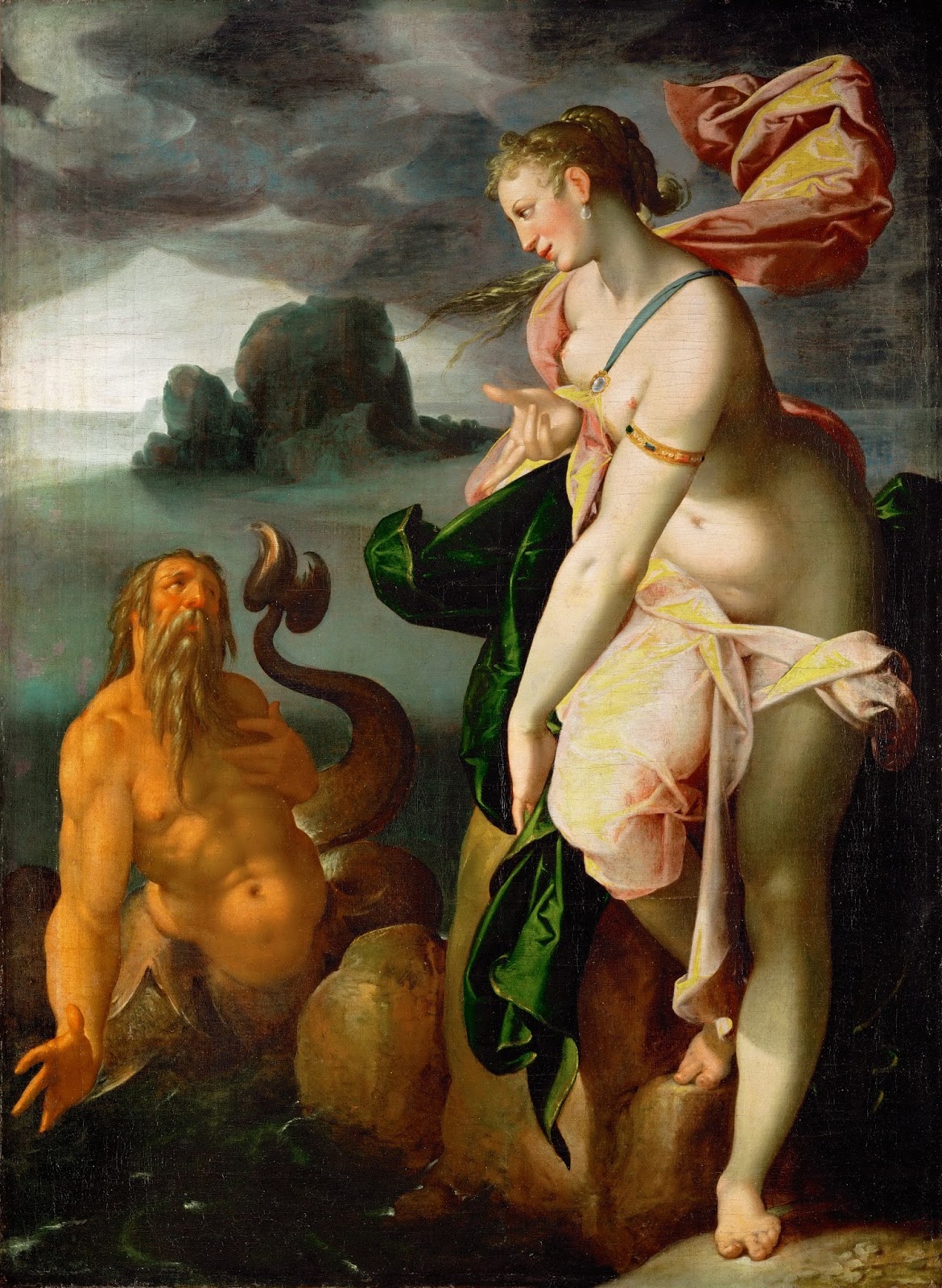
Scylla continued on, stopping to rest in a pool to refresh herself.  Glaucus, its inhabitant, desired the girl and pursued her though she fled.  Reaching a mountain peak that rose from the sea, she turned to see that he was part man and part fish, not sure whether to marvel or be terrified.  He was a god as important as Triton or Proteus, but  he used to be a man who worked always near the sea.  One day as he saw fish leave his net and walk back into the sea, he suspected the grass they had laid upon to be the source of their powers.  Chewing it, he felt himself metamorphosing, a desire welling up within him for the ocean.  He would have said more but Scylla had fled and he set out for the isle of Circe.  (See also Scylla in Book VIII)


Glaucus and Scylla (1580-82)
Bartholomäus Spranger
source Wikimedia Commons

With the sparring between Ajax and Ulysses, we seem to get more questions than answers.  The reader, as well as the chieftains, are trying to discover who has the most kleos (glory) to be worthy of the armour of Achilles.  Instead, we get two sides of action ---- the physical (Ajax) and the mental (Ulysses), and which one is most important?  An answer doesn't seem to be possible, and in the end, it is Ulysses' smooth tongue and not kleos that secures the prize.

Ovid does not seem to care for Thracians.  Not much good seems to come from them or be said about them.

Metamorphoses

Ajax's blood  ❥  purple flower
Hecuba's speech  ❥  barks/howls
Memnon  ❥  birds {Memnonides}
Daughter's of Anius' touch  ❥  wheat, wine, oil
Anius' daughters  ❥  snow-white doves
Orion's daughters' ashes  ❥  Coroni
Acis  ❥  river-god
Glaucus' lower body  ❥  fish