Wednesday, 10 June 2015

Incidents in the Life of a Slave Girl - Harriet Ann Jacobs

"Northerners know nothing at all about Slavery.  They think it is a perpetual bondage only.  They have no conception of the depth of degradation involved in that word, SLAVERY; if they had, they would never cease their efforts until so horrible a system was overthrown."

Being Canadian, and unlike my U.S. counterparts, I have little knowledge of the details and intricacies of the history of slavery in the United States, so I was pleased to note that my The Well-Educated Mind Biographies Project has a few books that cover this important, yet disturbing, period.  Incidents in the Life of a Slave Girl is the first book of this ilk on the list.  A book written in the tradition of the slave narrative and the sentimental novel, Jacobs strives to give a voice to the thousands of black men and women, who suffered abuse, injustice and the theft of their true identities under the yoke of slavery.

Jacobs (in the book calling herself Linda Brent), chronicles her story, beginning with her idyllic life within her family who are well-off slaves of a kind owner.  At her mother's death when Linda is six, she is sent to reside with her mistress who teaches her to read and write, but at the death of her owner, she is sold to the Flint family and her suffering begins.  Dr. Flint is harsh and cruel, developing a desire for Linda, and she is continually tormented by his sexual advances.  Thinking to save herself and her virtue, she begins a relationship with another white man and has two children with him in hopes Dr. Flint will cease his attentions.  Instead he is enraged and sends her and her children to do hard labour on one of his plantations.  The book further relates of her escape, her continuous concern about the fate of her children, seven years of her life in an attic so she is not discovered, and her final journey to the north and a relative freedom, although her expectations of her life there are perhaps somewhat disappointed.

Reward for notice for the return of
Harriet Jacobs by James Norcome (Dr. Flint)
source Wikipedia
Jacobs tells a touching and unique story from a woman's point-of-view, highlighting not only all the brutality and abuse the negro people suffered at the hands of some of their masters, but also the degradation to their spirits. Yet although Jacobs shows her people in their suffering, she also is able to emphasis their greatness of spirit:

"Truly, the colored race are the most cheerful and forgiving peole on the face of the earth.  That their masters sleep in safety is owing to their superabundance of heart; and yet they look upon their sufferings with less pity than they would bestow on those of a horse or dog."

While the book is full of horrid examples, Jacobs also strives to mention the white men and woman she met or observed in her life that showed kindness or compassion, and says of her benefactress, Mrs. Bruce:

"The noble heart!  The brave heart!  The tears are in my eyes while I write of her.  May the God of the helpless reward her for her sympathy with my persecuted people!"

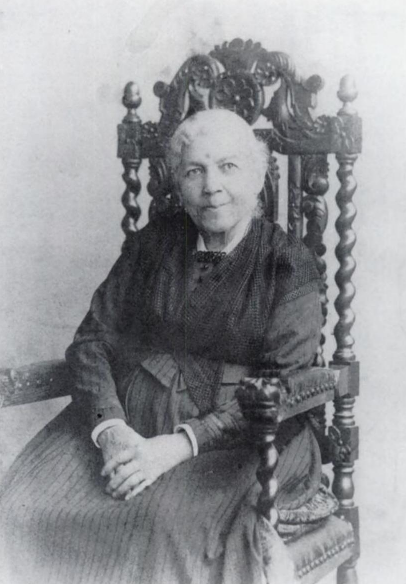
Harriet Ann Jacobs
source Wikipedia
While most of this book is at once both heartbreaking and wonderfully illuminating, there was an aspect of it that bothered me.  Jacobs was very clear and concise, and rightly so, with her denunciation of slavery and its assault on human dignity and the human spirit, but whenever a slave committed something from as small as a lack of good judgement to something as large as a crime, Jacobs excused their actions based on the treatment they had suffered under their masters.  For example, with regard to her decision to enter into a relationship and have children with Mr. Sands, she says:

"I feel that the slave woman ought to not to be judged by the same standards as others."

Later she states:

"I like a straightforward course, and am always reluctant to resort to subterfuges.  So far as my ways have been crooked, I charge them all upon slavery."

When she encounters a slave who has stolen money from his dead master, she declares:

"This is a fair specimen of how the moral sense is educated by slavery.  When a man has his wages stolen from him, year after year, and the laws sanction and enforce the theft, how can he be expected to have more regard to honesty than has the man who robs him?  I have become somewhat enlightened, but I confess that I agree with poor, ignorant, much-abused Luke, in thinking he had a right to that money, as a portion of his unpaid wages."

I don't disagree with Jacobs' premise that slavery can drive people to excesses, but I do disagree about excusing wrong behaviour with it.  Because someone has committed a wrong against you, does that give one the right to return the same in kind?  Couldn't this startling reasoning be as dangerous as the reasoning employed to bring the black people into slavery?  It reminded me of Aleksandr Solzhenitsyn's words, words from a man who had been both a commander and a persecuted soul, effectively both a master and a slave, and who finally learned that: "If only it were all so simple!  If only there were evil people somewhere insidiously committing evil deeds and it were necessary only to separate them from the rest of us and destroy them.  But the line dividing good and evils cuts through the heart of every human being.  And who is willing to destroy a piece of his own heart?"  The seeds that began slavery and other atrocities are within us all, it's important that man or woman, slave or free, persecuted or persecutor, that we are all aware of that piece and the danger it can do to ourselves and others.

In any case, it was a blemish on an otherwise excellent narrative.  Jacobs hatred of slavery in all its forms shows through as well as her overwhelming love and understanding for her fellow man.


Friday, 5 June 2015

The Club of Queer Trades by G.K. Chesterton

The Club of Queer Trades is a "society consisting exclusively of people who have invented some new and curious way of making money," and Chesterton's delightful collection of fantastical tales give us a view of these entrepreneurs who ply their trades in perhaps an unorthodox manner and often with surprising results.

The Tremendous Adventures of Major Brown: The subject of this title seeks out Rupert Grant, an amateur detective, and with the help of Swinburne, the narrator, and Grant's brother, Basil, a former "mad" judge, they proceed to cleverly solve his dilemma.  Retired and living comfortably and quietly in a tiny picturesque villa, Major Brown has a mania for pansies.  One day while strolling down a lane, he meets a man pushing flowers in a wheelbarrow and is convinced to purchase the pansies among them.  Yet before departing, the man whispers that if the Major will only climb the garden wall, he will see the most admired pansies in the whole of England.  Against his nature, Major Brown accepts a boost up and is flabbergasted by what he sees.  It is not the pansies themselves that catch his attention but the arrangement of them, spelling out "Death to Major Brown." Never one to quail in any situation, Brown introduces himself to the gardener of the house who takes him inside to meet a peculiar lady who is staring out the window, but he remembers to warn him beforehand not to mention the "jackal."   They begin to converse but suddenly their conversation is cut short by a blood-curdling screech, "Major Brown, Major Brown, where does the jackal dwell?"  When the Major runs outside, he spies a coal-black decapitated head on the sidewalk, where apparently the screams are coming from.  What is going on?  Who is trying to kill the Major?  And why does idiosyncratic Basil seem unconcerned?   Chesterton ties up his story with his usual aplomb, and yet still leaves you wondering.  There is also a neat contrast between Basil and Rupert, the former using his intellect and the latter acting on impulse.  A very fun tale!


The Painful Fall of a Great Reputation:  Charles Swinburne, the narrator of the last tale, and Basil Grant are travelling on the top of a deserted tramcar, speaking philosophically about the plight of the poor and the perception of them.  Basil declares that in spite of their circumstances, the majority of the poor are good people and that "the very vileness of life of these ordered plebeian places bears witness to the victory of the human soul."  No sooner has he uttered these words than he spies a man on the street and his astonishment is palpable.  He announces that he's observing the most wicked man in the world.  When Swinburne requests to know the man's sins, Grant admits that he has never seen him before this moment.  Swinburne is startlingly perplexed.  How has Basil made his assumption?  But there is no time to question as his friend grabs him and they are off on a chase after the most wicked man in the world.  In a world of fact versus impression and appearance versus reality, how are they to know whom to trust?


The Awful Reason of the Vicar's Visit:  Swinburne is dressing to meet Basil Grant at a dinner party when suddenly the sound of the doorbell resounds through the house.  It is the Reverend Ellis Shorter who has heard of his friend, Major Brown's adventures and has come to seek help.  Swinburne, impatient to be off to his engagement, gets impatient with the Vicar's dodderings and prevaricating whereupon the Vicar gives him leave to go, but states if he does not hear him out before he does, a man will be dead!  He relates a queer story of being kidnapped by a women's sewing club, and a subsequent photograph of himself that had never been taken.  Swinburne is perplexed and takes the vicar to Basil to sort out the mystery!


Reverend Oliver Maron, Vicar of Lancaster
George Romney 


The Singular Speculation of the House Agent:  Lieutenant Keith Drummond manages to excite Rupert's suspicions and barely concealed contempt with his larger-than-life stories and exaggerated claims.  Upon Drummond requesting a loan from Basil and claiming a visit to a house-agent, Rupert near demands to accompany him in hopes of exposing sinister purposes.  All four men set off together, and after a curiously unintelligible conversation between the odd little house agent and Drummond, in which the agent presents a ferret, some lizards and a spider, Drummond escapes before the rest.  When they follow him, they come upon a commotion and find that there has been a brawl. Drummond has been part of it, with his clothes torn and his sword, which he commonly carries with him, drawn.  The police get his address, yet Swinburne, Basil and Rupert discover the next day that the address was a fake.  Rupert is exultant with the proof of his suspicions of Drummond's disreputable character, but Basil merely laughs, claiming that Drummond his one of the most honest men and that truth can be stranger than fiction.  How can this be?  Is some of the mad judge's madness finally showing through?  The truth will be discovered at the address that doesn't exist.

Purley, Surrey (now south London)
source Wikipedia Commons


The Noticeable Conduct of Professor Chadd:  Basil Grant doesn't have many friends, but the ones he does have are a motley collection of idiosyncratic characters.  One day, he is discussing with his friend, Professor Chadd, an eminent ethnologist and expert on the relation of language to savages, the impact of science on the observable knowledge of Zulus versus the knowledge gained by living like a Zulu.  Chadd, a stuffy academic, who has recently been appointed as curator of the Asiatic manuscripts at the British Museum, answers in stuffy, didactic prose.  The next morning, Basil receives a telegram from one of Chadd's three sisters: Chadd has suffered a mental breakdown and Basil is entreated to come at once.  Upon his arrival, Basil discovers that the Professor will not communicate with anyone and, instead, will only move his legs in a kind of rigid, hopping dance.  The doctor is with him and when Basil approaches, he asks for a moment with his friend.  The observers are surprised to see the respectable Mr. Grant with a paper and pencil, following Chadd about and jotting notes as he goes.  They are further astounded when he begins to hop around in a parody of Chadd.  The situation is further complicated with the arrival of Mr. Bingham of the British Museum. Great Scots!  How can a lunatic be curator of the Asiatic manuscripts?!!  Yet Basil declares to Bingham that they need to pay Chadd £800 per year until he stops dancing.  What?  Has Basil gone mad as well?  Are there two lunatics, one or none?

Bedford Gardens, Bloomsbury
source Wikimedia Commons


The Eccentric Seclusion of the Old Lady:  Swinburne is walking with his friend, Rupert Grant, the amateur detective, when Grant spots a milkman walking ahead of them.  Suspicious because of the careless way the man carries his milk can, Grant swears that if they follow him, they will find a mystery at the end of the trail.  When the milkman disappears down area steps to a basement, Grant follows and emerges triumphant.  He has heard a cry for help in the downstairs room, repeating, "When shall I get out?  Will they ever let me out?".  Determined to rescue the imprisoned lady, they enlist Basil's help and with his usual aplomb, Basil gains entry to the house but when he emerges, he claims that the men inside are good chaps.  Incensed, both Rupert and Swinburne insist on entering the house themselves to find the victim.  The "chaps" allow them in but a fight ensues in which our three rescuers are pinned.  Will they get free to release the poor woman who's been detained?  Yet with Basil Grant, nothing is every as it seems.

Milkman and cart 1900s
source Wikimedia Commons


In Basil Grant, Chesterton creates, not a scientifically brilliant detective like Sherlock Holmes, but one who is astute in the workings of human nature, which makes for truly fascinating cases.  Another fantastic effort by Chesterton who keeps the reader guessing, and never quite sure whether up is down or down is up in The Club of Queer Trades.


Friday, 29 May 2015

A Panegyric for Dorothy L. Sayers by C.S. Lewis


Dorothy L. Sayers is best known for her Peter Wimsey mysteries, but she was also a playwright, poet, essayist, and theologian, writing such books as The Man Born to Be King, Creed or Chaos?, The Mind of the Maker, and Are Women Human?  In her own eyes, her finest work was her translation of The Divine Comedy.

Both Lewis and Sayers completed their academic studies at Oxford University and their first meeting was through a fan letter that Sayers wrote to Lewis upon reading his The Screwtape Letters.

"She was the first person of importance who ever wrote me a fan letter ........  I liked her, originally, because she liked me; later for the extraordinary zest and as edge of her conversation ---- as I like high wind.  She was friend, not an ally." (Lewis)
Dorothy L. Sayers
source The Dorothy L. Sayers Society


In this panegyric read at Sayers' funeral, Lewis praises Sayers' literary work. While he admits to not being a fan of detective fiction, he nevertheless respects their authors and explains that, contrary to rumours that Sayers was later ashamed of her "tekkies", she had merely "felt she had done all that she could" with the genre.  He claims there is no "cleavage" between her detective work and her later theological works, citing Pascal's quote, "One shows one's greatness not by being at an extremity but by being simultaneously at two extremities."  He discusses the writing of Christian works, the problems of the intrusion of self and the commonalities between detective fiction and religious writing.

With regard to the importance Sayers placed on the quality of writing, he quotes from her The Man Born to Be King, "Let me tell you, good Christian people, an honest writer would be ashamed to treat a nursery tale as you have treated the greatest drama in history: and this in virtue, not of his faith, but of his calling."  The intention to behave piously was no excuse for a job poorly done.

Finally, he praises her work of the translation of Dante's The Divine Comedy and goes on to say of her independent character:
" For all she did and was, for delight and instruction, for her militant loyalty as a friend, for courage and honesty, for the richly feminine qualities which showed through a port and manner superficially masculine and even gleefully ogreish ---- let us thank the Author who invented her."

This essay can be found in:  


Deal Me In Challenge #14 - Five of Spades

Tuesday, 26 May 2015

Walden by Henry David Thoreau

"When I wrote the following pages, or rather the bulk of them, I lived alone, in the woods, a mile from any neighbor, in a house which I had built myself, on the shore of Walden Pond, in Concord, Massachusetts, and earned my living by labor of my hands only."

Transcendentalist Henry David Thoreau wrote Walden, his magnum opus, during a two year stay on lands owned by his friend, Ralph Waldo Emerson.  Walden Pond, situated in Walden Woods, was an untouched centre of beauty among the agricultural lands of Concord, Massechusetts, and his sojourn there allowed Thoreau the peaceful reflection that he so earnestly sought.

"I went to the woods because I wished to live deliberately, to front only the essential facts of life, and see if I could not learn what it had to teach, and not, when I came to die, discover that I had not lived.  I did not wish to live what was not life, living is so dear; nor did I wish to practice resignation, unless it was quite necessary.  I wanted to live deep and suck out all the marrow of life, to live so sturdily and Spartan-like as to put to rout all that was not life, to cut a broad swath and shave close, to drive life into a corner, and reduce it to its lowest terms, and, if it proved to be mean, why then to get the whole and genuine meanness of it, and publish its meanness to the world; or if it were sublime, to know it by experience, and be able to give a true account of it in my next excursion."

Thoreau's reasons for retreating to the woods, his construction of a cabin, his pastoral descriptions of nature, and his philosophy surrounding interaction with nature and solitude, permeate the pages and take us into a world and perceptions that stretch our thinking and make us long for something simpler. Thoreau makes us face the realities of life and prods us to examine the value received from our choices.  Do we live according to our own hearts and convictions or by society's dictates, and how are we changed by our choices?

Surprisingly, given its present popularity, Walden was rejected by eight publishers before being printed, and experienced only a negligible success during Thoreau's lifetime, finally becoming popular during the 20th century with the advent of the Civil Rights era.

Walden Pond in late June
source Wikimedia Commons


There were parts of this book that I loved and could completely relate to.  I have my own version of Walden Pond in the summer.  I know the call of the eagle, the blue blur of a dragonfly, the slap of a beaver's tail on the water.  I understand the workings of an isolated community, with close interactions, yet subtly observed personal boundaries.  I understand what silence means and the benefit of the education received through it.  Returning to a life unhampered by unnecessary busyness and useless striving certainly renews your spirit and allows you to become more synchronized with nature and with humanity.


My Walden Pond
© Cleo @ Classical Carousel

"We must learn to reawaken and keep ourselves awake, not by mechanical aids, but by an infinite expectation of the dawn, which does not forsake us even in our soundest sleep.  I know of no more encouraging fact than the unquestionable ability of man to elevate his life by a conscious endeavour.  It is something to be able to paint a particular picture, or to carve a statue, and so to make a few objects beautiful; but it is far more glorious to carve and paint the very atmosphere and medium through which we look, which morally we can do.  To affect the quality of the day, that is the highest of arts."

"Live in each season as it passes; breathe the air, drink the drink, taste the fruit, and resign yourself to the influence of the earth."

© Cleo @ Classical Carousel


Thoreau entreats us not only to strive to live simply but to be happy with little and therefore, recognize that as we grow poor in possessions, we grow rich in spirit.

"However mean your life is, meet and live it; do not shun it and call it hard names.  It is not so bad as you are.  It looks poorest when you are richest.  The fault-finder will find faults even in paradise.  Love your life, poor as it is.  You may perhaps have some pleasant, thrilling, glorious hours, even in a poorhouse.  The setting sun is reflected from the windows of the almshouse as brightly as from the rich man's abode; the snow melts before its doors as early in the spring.  Cultivate property like a garden herb, like sage.  Do not trouble yourself much to get new things, whether clothes or friends.  Turn the old; return to them.  Things do not change; we change.  Sell your clothes and keep your thoughts .......  Superfluous wealth can buy superfluities only.  Money is not required to buy one necessary of the soul."
"My greatest skill in life has been to want but little"

While Thoreau's wilderness experience was unique, I'm not sure that he was recommending that everyone pack up and make for the woods.  In his words, I heard him entreat people to have some sort of experience with nature, to take the time to explore it, to open yourself up to it in a quiet, introspective kind of way and, within that experience, nature will teach you to know yourself better.

"For a week I heard the circling groping clangor of some solitary goose in the foggy mornings, seeking its companion, and still peopling the woods with the sound of a larger life than they could sustain.  In April the pigeons were seen again flying express in small flocks, and in due time I heard the martins twittering over my clearing, though it had not seemed that the township contained so many that it could afford me any, and I fancied that they were peculiarly of the ancient race that dwelt in hollow trees ere white men came.  In almost all climes the tortoise and the frog are among the precursors and heralds of this season, and birds fly with song and glancing plumage, and plants spring and bloom, and winds blow, to correct this slight oscillation of the poles and preserve the equilibrium of Nature."

While I loved reading about Thoreau's temporary experiment, this is not the easiest book to get through.  At times Thoreau overwhelms you with his spiritual philosophy and I found myself wondering at how he could become an expert with merely a two year stint in only comparative isolation, as he was near Concord and often had visitors to his abode.  However, these flaws did not diminish some rather obvious truths in Thoreau's vision.  He allowed nature to be his Muse, simplicity his guide and he leads us on a soul-searching journey into the woods, opening our eyes to the world around us.

I found this video on YouTube and I think it echoes some of Thoreau's thoughts beautifully ..... "and see if I could not learn what it had to teach, and not, when I came to die, discover that I had not lived." 

 Figuring Life Out


Sunday, 24 May 2015

Beowulf Read-Along Starting Week Four


Beowulf Read-Along
Week 4 - May 22 - 31; Lines 2200 - End
_____________________________________


WEEK 4:

VOCABULARY
  
suppurate: form pus; fester

foment: instigate or stir up; incite

howe: hollow place

graith: accountrements; dress; gear

hoke: don't know!

__________________________________________________

Quick Summary:  Time passes and Hygelac is killed in battle with the Shylfings, Headred his son takes over and Beowulf, though prodded to take the kingdom from Headred, instead supports him and only becomes King at Headred's death.  He rules as a wise and successful king for 50 years.  Unbeknownst to the Geats, a dragon lurks in a barrow, where it guards a cursed treasure beyond wonders, and is finally stirred by a thief, a slave who steals a precious cup and awakens the creature's wrath.  In his hunt, the dragon burns Beowulf's throne-hall and Beowulf knows that he must confront this adversary in spite of foreseeing his own death.  When he faces the dragon, only Wiglaf, a kinsman, remains to assist him, and while Beowulf kills the dragon, he is mortally wounded.  Upon his death, Wiglaf prophecies defeat for the Geats at the hands of the Swedes because of their cowardice and the fact they are without a king.  The treasure is left as it was found, under a curse and Beowulf is given a noble funeral, a tribute to the remarkable and honoured king that he was.

_______________________________________ 


Lines 2200 - 2396

We notice at this point of the poem, Beowulf has ruled fifty winters, the same amount of time that Hrothgar had ruled when Beowulf came to his aid: " ...... He ruled it well for fifty winters, grew old and wise as warden of the land ...... " (Lines 2208-2210)

Like Grendel had threatened Heorot, the dragon threatens the Geats.

We get a flashback to Hygelac's death and receive more evidence of Beowulf's "consideration" and honourable behaviour when he refused to usurp Heardred and his inheritance of the throne of the Geats: " ..... with Hygelac dead, she (Hygd) has no belief in her son's ability to defend their homeland against foreign invaders. Yet there was no way the weakened nation could get Beowulf to give in and agree to be elevated over Heardred as his lord or to undertake the office of kingship. But he did provide support for the prince, honoured and minded him until he matured as the ruler of Geatland ....... " then after a fight with the sons of Ohthere : " .... Heardred lay slaughtered and Onela returned to the land of Sweden, leaving Beowulf to ascend the throne, to sit in majesty and rule over the Geats. He was a good king....." Beowulf passed up an opportunity for power and instead chooses to give Heardred his rightful inheritance and support him in his rule. An amazing choice that shows his loyalty, graciousness and his desire to do what is right. (Lines 2355 - 2390)


Lines 2397 - 2586

It is as if Beowulf feels his mortality as he recounts his earlier days and the stories surrounding his people. His last boast contains the highest goal of glory again: " ..... I shall pursue this fight for the glory of winning ......." (Lines 2425 - 2515)

I was a little perplexed as to why Beowulf announces himself to the dragon: " ..... The lord of the Geats unburndened his breast and broke out in a storm of anger. Under grey stone his voice challenged and resounded clearly. Hate was ignited. The hoard-guard recognized a human voice ......" Doesn't it seem imminently sensible to sneak in and kill the creature, if he can? Again, it is as if Beowulf sets up for himself the ultimate challenge. (Lines 2516 - 2557)

What is it with these swords??! " ...... Beowulf was foiled of a glorious victory. The glittering sword, infallible before that day, failed when he unsheathed it, as it never should have......" First he decides to fight Grendel without a sword; then he decides to use a sword against Grendel's mother; Unferth's sword fails him so he has to use one he finds in the barrow; now he decides to use a sword but it fails. Infallible swords that fail in the highest time of crisis ........ I can't help but think that there is an important point in all this that I'm missing, but I cannot for the life of me find it. (Lines 2583 - 2586)

  
Lines 2587 - 2801

" ...... No help or backing was to be had then from his high-born comrades; that hand-picked troop broke ranks and ran for their lives to the safety of the wood ....... in a man of worth the claims of kinship cannot be denied ....." After his men stood by him against Grendel, why do these ones run away? Cowardice? Fate? A sigh of a weaker people with less honour? Yet his kinsman, Wiglaf, stands by him. Perhaps the scene is simply a device to ensure that the reader sees Wiglaf's loyalty and therefore the fact that he is to be Beowulf's heir will be believable. Wiglaf then scolds the Thanes and he appears to try to shame them into standing by their lord but ends up going in to face the dragon with only Beowulf as his fellow-warrior. (2592 - 2630)

" ..... When he wielded a sword, no matter how blooded and hard-edged the blade his hand was too strong, the stroke he dealt (I have heard) would ruin it. He could reap no advantage ....." This appears to be an explanation of the failed swords, but if you examine the previous instance it appears that his sword had never failed him but failed him now, which would have had nothing to do with his strength. Yes, it is a conundrum. (Lines 2684 - 2687)

Beowulf fatally wounds the dragon but is wounded/poisoned by the creature and recounts his rule as his life fades away. Initially he wants to see the treasure: " ........ I want to examine the ancient gold, gaze my fill on those garnered jewels; my going will be easier for having seen the treasure, a less troubled letting-go of the life and lordship I have long maintained ......." and then refers to his people: " ....... To the everlasting Lord of All, to the King of Glory, I give thanks that I behold this treasure here in front of me, that I have been allowed to leave my people so well endowed on the day I die. Now that I have bartered my last breath to own this forune, it is up to you to look after their needs ......." He clearly intend the treasure for his people even though he trusts God to take care of their needs. (Lines 2702 - 2801)


Lines 2802 - End

Wiglaf then rebukes the Thanes for betraying Beowulf in their cowardice and foretells that this one act will be known and cause the Geats to be attacked by their enemies, who will take advantage of their weakness. With the death of their peace-maker, who has maintained that peace through bravery and empathy, signifies the death of that peace and perhaps the death of their people. (Lines 2860 - 3027)

There are 50's showing up regularly in this poem, 50 years of rule from both kings, the dragon was 50 feet in length and I think I saw another 50 somewhere. I wonder if this is meaningful or not .....???


" ....... Yet Beowulf's gaze at the gold treasure when he first saw it was not selfish ....." More proof of Beowulf's unusual qualities ...... Wiglaf then indicates that Beowulf was intent on possessing the treasure and did not listen to their warning to leave the dragon alone. He orders Beowulf's funeral pyre, removes the treasure, we see Beowulf's funeral and then the surprising end ....... " ........ They (the Geats) let the ground keep that ancestral treasure, gold under gravel, gone to earth, as useless to men now as it ever was ......" Wiglaf takes the changes in Beowulf a step further, not only renouncing the value of spoils (treasure) but questioning its value throughout history. The poem ends with a tribute to its hero: " ...... They said that of all the kings upon the earth he was the man most gracious and fair-minded, kindest to his people and keenest to win fame." (Lines 3074 - 3182 [End])

Does Beowulf's legacy pass to Wiglaf, making him a new type of hero, or does the culture of fate and destiny still have a hold on this society?

For me, these last sections of the poem were the most difficult to understand, with many possible contradictions; the history of the treasure; the importance of the treasure to the poem --- is it a symbol of fame and glory or a warning symbol of materialism and its effect on society; the significance of the number 50; we have more death caused by kin -- what does this mean?; the contrast between Beowulf's earlier contest with Grendel and this contest with the dragon; God not allowing Grendel near Hrothgar's throne yet he allows the dragon to destroy Beowulf's throne-hall, etc.  So many interweaving threads in this story leave wonderful trails to follow and with my fifth read of the poem I'm still pondering the implications of the themes it contains.  

I'd love to hear the comments of those of you still with us!


Tuesday, 19 May 2015

Erewhon by Samuel Butler

"If the reader will excuse me, I will say nothing of my antecedents, nor of the circumstances which led me to leave my native country; the narrative would be tedious to him and and painful to myself."

I've been reading oodles of satirical fiction lately and entirely inadvertently, as this genre just seems to be dropping onto my lap.  My first taste of utopian satire was given to me by Voltaire's Candide, which left me rather unsure if we were going to be good friends.  Then came Utopia by Thomas More and I was firmly hooked, only to have my enjoyment of it further strengthened with my read of Gulliver's Travels.  My most recent Classics Club spin book landed me with Erewhon by Samuel Butler.  I was somewhat familiar with Butler from my skimming of some of his translation of The Odyssey (wouldn't recommend it for a first read) so I wasn't quite sure what to expect.  Would he be a Voltaire, or a Swift or somewhere happily in between?

The narrator of Erewhon, Higgs, tells the reader of his journey to a fictional country, in fact, modelled on the country of New Zealand where Butler spent the early part of his life.  Higgs loses his native guide, Chowbok, on a trek into the wild, and manages to wander into a society who, while they resemble the human race, have completely different standards for managing their nation.

Map of part of New Zealand to illustrate
Erewhon & Erewhon Revisited
source Wikipedia

Butler explicates on some rather curious aspects of Erewhon society.  For a start, the Erewhons view machines as dangerous to their community and anyone caught with one can be at risk of being put to death.  Machines are regarded as having a greater ability than people in that they are growing and evolving at an exponential rate and thus, they have the capacity to enslave mankind.  The Erewhons also view immorality as a sickness and actual illness as a crime.  For example, a man who has lost his wife to illness is tried as a criminal, yet is lauded for his action of raising her insurance premium immediately before her death and, therefore, benefiting from it before he'd paid even two premiums.  There are other curious idiosyncrasies to this society, such as the repellent manner with which they view birth, the rights of animals and vegetables, and their promotion of the idea of unreason, claiming that reason could not exist without it.

Samuel Butler's Mesopotamian Homestead
New Zealand
source Wikimedia Commons


Butler claimed that Erewhon nearly wrote itself with some resistance from its author:

"I did not want to write Erewhon.  I wanted to go on painting and found it an abominable nuissance being dragged willy-nilly into writing it.  So with all my books --- the subjects were never of my own choosing; they pressed themselves upon me with more force than I could resist.  If I had not liked the subjects I would have kicked and nothing would have got me to do them at all.  As I did like the subjects and the books came and said they were to be written, I grumbled a little and wrote them."

Apparently it was Butler's aim to make a commentary on the ills of Victorian society, but I had a difficult time finding Butler's voice in the prose.  With Voltaire or Swift, it was easier to see the issues that they were targeting with their criticism, but Butler was more obscure.  He presented issues, but was less clear as to which side of the fence he stood, as some of the most ridiculous laws often had an element of truth to them.  In fact, in a second preface to the book, Butler had to correct some misconceptions with regard to his novel, stating that contrary to the assumption that he was showing Darwin's theory of evolution as absurd, in fact, he had a healthy respect for it, and he goes on, quite charmingly, to blame the Erewhons for all the inconsistencies in the story. For me, the novel soon degraded into great swathes of philosophical narrative with little to prop it up.  I love philosophy, but to engage a reader one needs the background of a story to support it; Butler attempted the reverse in hoping that his philosophy would prop up his story.  This approach only served to weaken the novel as a whole.

In spite of the novel's mediocrity, it is quite obvious that Butler was a great thinker who explored some fascinating ideas that remain with us in the 21st century.  His analogy between crime and disease, the over-emphasis on appearance of an individual, and the especially significant topic of how humans interact with technology and their enslavement to it are all powerful issues that still resonate with us through the centuries.

" .... so ingrained in the human heart is the desire to believe that some people really do know what they say they know, and can thus save them from the trouble of thinking for themselves, that in a short time would-be philosophers and faddists became more powerful than ever, and gradually led their countrymen to accept all those absurd views of life ...... I can see no hope for the Erewhonians till they have got to understand that reason, uncorrected by instinct, is as bad as instinct uncorrected by reason ...."


Saturday, 16 May 2015

Beowulf Read-Along: Starting Week Three


Beowulf Read-Along
Week 3 - May 17 - 24; Lines 1251 - 2199
____________________________________________

VOCABULARY

kesh: causeway or log bridge

bulwark: a solid wall-like structure

brehon: ancient Irish lawyer or judge

thane: warrior, follower, servant

damascene: decorated sword or steel with peculiar markings

sept: a family or group of families under a head

gorget: a piece of armour for defending the throat
_______________________________________

Quick Summary:  However ………. joy and celebration come too soon to Heorot, as Grendel’s mother arrives to reek vengeance for the death of her son.  She carries away Hrothgar’s most trusted warrior and friend, Aeschere, and so the Geats and the Danes are off in pursuit.  They come to a lake writhing with serpents and sea creatures, and Beowulf volunteers to attempt to kill the monster.  He swims for nearly a day until he is caught in the grasp of the dam and taken to her cavern, where the blade Unferth gave him fails and he is forced to take a different one from the wall to complete the killing.  To everyone’s shock, Beowulf emerges from the water victorious.  He is once again celebrated, and there are stories told which are intended to instruct character.  The Geats return to their king and Beowulf relates his adventures.

_______________________________________ 

Lines 1251 - 1441

And so Grendel's mother comes to Heorot to avenge his death and leaves with her son's arm and one of Hrothgar's most trusted friends.

Again we see the theme of winning glory as the highest goal in life: " ..... It is always better to avenge dear ones than to indulge in mourning. For every one of us, living in this world means waiting for our end. Let whoever can win glory before death. When a warrior is gone, that will be his best and only bulwark......" So it is not only vengeance that is called for, but the desire to win fame for oneself.  (Line 1384-1389)

It is curious that Beowulf almost chastizes Hrothgar at the end of this section: " ...... Endure your troubles to-day. Bear up and be the man I expect you to be ...." Do I sense a frustration on Beowulf's part with Hrothgar's lack of action? Not at all the way I would expect someone to talk to a king, and I think it shows the power Beowulf wields over him. (Line 1395-1396)

What an effective scene where they come upon Aeschere's head at the foot of the cliff and then see the water surging with different kinds of reptiles, and sea-dragons and monsters "slouching on slopes by the cliff". I wonder what a sea-dragon looks like ...... Perhaps like this:


Lines 1442 - 1491

Now comes one of the parts that fascinate me; Unferth lends Beowulf his sword, Hrunting, which has never failed in battle. " .... (he - Unferth) could hardly have remembered the ranting speech he had made in his cups. He was not man enough to face the turmoil of a fight under water and the risk of his life. So there he lost fame and repute ...."  So it is reasonably obvious that Unferth has altered his original opinion of Beowulf after seeing his defeat of Grendel, gaining a healthy respect for him and even lending him his precious sword. It also appears as if a warrior's reputation is like a bank account; every time he performs an heroic feat, he makes a deposit of glory but every time he shows an act of cowardice, glory is withdrawn. In this instance, one act of cowardice seems to clear his whole account! (Line 1455-1491)

Then we see Beowulf not only take the sword, Hrunting, but he then bequeaths his own sword to Unferth if he does not return. This is uncommon courtesy shown to a man who did nothing but taunt and jeer at him when he first came to Heorot. He should have killed Unferth for his insults, yet he shows a tolerance and then a grace that is quite perplexing given the society in which he lives, and yet is quite appealing.

" ..... With Hrunting I shall gain glory or die! ....." Hmmm ...... we shall see ...... (Line 1491)


Lines 1492 - 1650

" ..... then (he) heaved his war-sword and swung his arm: the decorated blade came down ringing and singing on her head. But he soon found his battle-torch extinguished: the shining blade refused to bite. It spared her and failed the man in his need. It had gone through many hand-to-hand fights, had hewed the armour and helmets of the doomed, but here at last the fabulous powers of that heirloom failed ....."  (Line 1520-1528)

So Unferth's sword proves of no use to him. I wonder why he decided to use a sword on Grendel's mother but not on Grendel? Did he feel she would be easier to kill? Had he earned enough glory with killing Grendel and did not need to earn such overwhelming renown? I can't even guess the answer to this one.

But finally he finds a sword in Grendel's mother's den that does the trick and he lops off her head. He then finds Grendel and decapitates him before bringing his head to the surface.

Oh, the lack of faith of the Shieldings for Beowulf's success. They all assume he is dead and skedaddle, but Beowulf's thanes wait in hope and finally their hero emerges with Grendel's head and the hilt of the sword.

So with this last act of Beowulf's, " .... his courage was proven, his glory was secure ....." Can he not lose his glory now because of these amazing feats of courage and bravery? A deposit that cannot be decreased?? (Line 1646)


Lines 1651 - 1790

Beowulf returns to Heorot to explain what happened during his sojourn into the depths of the waters after Grendel's mother, and afterwards Hrothgar launches into a very long speech. It includes:

.... Hrothgar's values: " .... A protector of his people, pledged to uphold truth, justice and to respect tradition ....."  (Line 1700-1701)

..... Beowulf's character: " ..... In all things you are even-tempered, prudent and resolute ......"  (Line 1705-1706)

...... Hrothgar tells the story of King Heremod and contrasts him with Beowulf. He instructs Beowulf to, " ..... learn from this and understand true values. I who tell you have wintered into wisdom ....." He follows this story with a cautionary monologue on the dangers of power without generosity and gratitude, and gives his own situation of an example of a journey from power to grief and helplessness. He exhorts Beowulf to live a life that is not focussed on material possessions or "external rewards". Is he suggesting he concentrate on an internal building of character? Hmmm ..... doesn't sound like advice from a king of a culture whose status is built upon winning glory and spoils ........ (Line 1709-1768)


Lines 1791 - 1887

" ........ Then that stalwart fighter ordered Hrunting to be brought to Unferth, and bade Unferth take the sword and thanked him for lending it. He said he had found it a friend in battle and a powerful help; he put no blame on the blade's cutting edge. He was a considerate man....."

Wow! Again, Beowulf's actions appear to be outside the cultural norm. He thanked him and then lied about the degree of help the sword had been to him to spare Unferth's feelings?! He certainly shows a consideration that defies explanation, especially after Unferth had originally mocked and challenged him. (Lines 1807 - 1812)

Hrothgar says more kind words regarding Beowulf and there is a foreshadowing when he says: " ..... and you are still alive, then I firmly believe the seafaring Geats won't find a man worthier of acclaim as their king and defender than you, if only you would undertake the lordship of your homeland......" It appears that Beowulf has not only won glory but also Hrothgar's backing if ever an opportunity arises for him to become king of the Geats. (Lines 1849-1853)

We saw Wealhtheow, Hrothgar's queen, being a peace-weaver in the last section as she pleaded for Beowulf's consideration for her sons, but we see a similar attribution given to Beowulf: " ...... What you have done is to draw two peoples, the Geat nation and us neighbouring Danes, into shared peace and a pact of friendship in spite of hatreds we have harboured in the past ......"  Beowulf, too, is a peace-weaver. He has made peace with Unferth, Hrothgar and the Danes, and his own version of peace with Grendel and his dame. (Lines 1855-1857)

This was such a lovely part of the poem:

" .... And so the good and grey-haired Dane, that high-born king, kissed Beowulf and embraced his neck, then broke down in sudden tears. Two forebodings disturbed him in his wisdom, but one was stronger: nevermore would they meet each other face to face. And such was his affection that he could not help being overcome: his fondness for the man was so deep-founded, it warmed his heart and wound the heartstrings tight in his breast ......" and " ...... He was a peerless king until old age sapped his strength and did him mortal harm, as it has done so many ....." Again, Beowulf could have brought war to Hrothgar in his weakness and taken over his kingdom but instead he assisted him and won a friend and ally. However, we didn't find out what the second thought that disturbed Hrothgar was, did we? (Lines 1870 - 1887)


Lines 1888 - 2199

The Geats appear to have a quick sail home, Beowulf brings his treasure to King Hygelac and Queen Hygd, we hear a story about Queen Modthryth, who is harsh and quick to deal punishment, until she is married to Offa whose influence appears to have worked great improvement in her character. Again, I'm not quite sure as to the purpose of the interposed story.  Perhaps simply a contrast of queens; how one should act (as a peace-weaver) and how one should not act (as a tyrant).

When Beowulf meets Hygelac, the king of the Geats says: "..... Did you help Hrothgar much in the end? Could you ease the prince of his well-known troubles? Your undertaking cast my spirits down, I dreaded the outcome of your expedition and pleaded with you long and hard to leave the killer be, let the South-Danes settle their own blood-feud with Grendel ......" Two points strike me here; first, all the peoples appeared to well know the problems and tragedy that Hrothgar faced with Grendel, yet no one was willing to help except Beowulf. I also noted that Beowulf went against his king's wishes when he sailed for Heorot, and I think this infers his position was a well-respected and honoured one if he was allowed to do as he wished without the approval of the king. However, later it says the king originally did not think much of him so perhaps it is simply that Hygelac does not value Beowulf and therefore, does not really care what he does .....??? (Lines 1990 - 1998)

Beowulf begins to recount his tale but deviates from his story and begins to prophesy about the marriage of Hrothgar's daughter and the tragedy that will happen, once again in the good, old blood-feud fashion. (Lines 2020 - 2068)

I was fascinated that Beowulf declined to go into detail about his heroic exploits: " ..... It would take too long to tell how I repaid the terror of the land for every life he took and so won credit for you, my king and for all your people ......" Shocking that he would miss a chance to build his glory in the eyes of others and put the focus on his king and people. (Lines 2092 - 2095)

" ...... Thus Beowulf bore himself with valour; he was formidable in battle yet behaved with honour and took no advantage; never cut down a comrade who was drunk, kept his temper and, warrior that he was, watched and controlled his God-sent strength and his outstanding natural powers. He had been poorly regarded for a long time, was taken by the Geats for less than he was worth: and their lord too had never much esteemed him in the mead-hall. They firmly believed that he lacked force, that the prince was a weakling; but presently every affront to his deserving was reversed ...." (Line 2177-2189)  Initially, the Geats did not appreciate his virtues of consideration, kindness, empathy and temperance because they did not fit with their society and they did not understand them, but when these virtues were coupled with bravery, courage, and force of action, he finally got the recognition he deserved. Yet Beowulf appears to be a new type of warrior, a new type of person foreshadowing a new type of society. What do the rest of you think?

Week 4 starting post will go up on May 24th!