Thursday, 8 October 2015

The Canterbury Tales ~~ The Tale of Sir Thopas

The Host spies Chaucer and commands him to tell a tale of mirth, while describing some of his manner and looks.  Chaucer claims to know no other tale except for a rhyming romance that he learned, and so he begins.


The Tale of Sir Thopas


Sir Thopas was born at Popering in Flanders, and was a lord known for his fair and gentle manners.  A description of his pleasing person follows, along with praises of his sporting aptitude and his ability to capture female hearts.  But no, Sir Thopas is chaste, and out he goes into the forest where he is overcome by love and dreams of an Elf-queen as his sweetheart. (Heavens, this is starting to remind me of an Arthurian story!)  He rode long enough to find the country of Fairy.  Intercepted by a giant named Olifaunt, who threatens him, they have an altercation and Thopas escapes, but not before promising to deal with him at a later date.

He gathers his men to fight the giant, our slender and gay Sir Thopas, and here follows long descriptions of his food, and his battle clothing and array, until the Host can stand it no more and begs Chaucer to cease his tale, labelling it as doggerel verse which is used to produce a comic effect. Chaucer protests at this treatment, but the Host claims his rhyme is "crappy" and a waste of time.  He will only be permitted to proceed if he tells something in alliterative verse or prose, so Chacuer agrees to prose but warns his story may have echoes of other stories already told.  He proceeds with The Tale of Melibee.

Warwick Goble

Thopas seems to abandon the realities of life and prefers to search out fantastical experiences with such fanciful characters as Elf-queens and giants. It was also laughable to see the Host chastize Chaucer, not for telling a boring story, but for telling one that was simply too atrociously inept to be listened to.

How very amusing to see Chaucer poke some fun at himself!  I rather wondered though, if there were not some deeper meanings that I was missing, that would have made the tale so enjoyable for the listeners of the time, such as style and rhyme and syntax and word-choice.  There are subtleties that were common for that era that aren't so obvious now, and I lack the appreciation I could have garnered with that antiquated knowledge.  In any case, I'm now curious as to what Chaucer will do with Melibee.  Will it be a serious story, or more tongue-in-cheek teasing?  


Tuesday, 6 October 2015

Hamlet ~ Act I Scene II

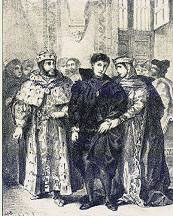
The Queen consoles Hamlet (1834)
Act I, Scene II
Eugene Delacroix
source Wikimedia Commons

Hamlet  ~~  Act I,  Scene II


The new King, Hamlet's brother Claudius, laments the old king's passing and claims that he wed the Queen in both mirth and sadness.  He hints that Fortinbras thinks the kingdom weak because of King Hamlet's death and says he has contacted the King of Norway, Fortinbras' uncle, who is debilitated and bedridden, to stop his nephew's plotting.  He sends Cornelius and Voltemand to deliver another letter to Norway.

John Barrymore as Hamlet (1922)
source Wikipedia
Laertes, son of Polonius, asks leave to return to France since he has done his duty by attending Claudius' coronation.  After securing Polonius' opinion, Claudius allows him to go, and then turns to Hamlet, asking why "clouds still hang on (him)". Gertrude, the Queen, urges her son to accept her new husband and no longer mourn his father's death. Hamlet claims his grief surpasses what can be viewed on the surface, yet Claudius pleads with him to stave off his melancholy, as it is not manly and goes against God and nature.  He is Hamlet's new father and wishes him to remain near him instead of going to Wittenberg, as Hamlet plans.  Hamlet agrees.

Hamlet then laments his father's death and agonizes over the alacrity with which his mother remarried after her apparent devotedness to her first husband.  Horatio, Marcellus and Barnardo appear and Hamlet questions why they aren't in Wittenberg, whereupon they reply that they came for his father's funeral.  Hamlet mentions his mother's marriage and then claims to see his father in his imagination.  It's the perfect opening for the sentinels, who tell him of the ghost of his father.  He asks of its appearance and if his friends are armed, then promises to meet them that night between eleven and twelve o'clock.

"My father's spirit in arms.   All is not well.
I doubt some foul play.  Would the night were come!
Till then sit still, my soul.  Foul deeds will rise,
Though all the earth o'erwhelm them, to men's eyes."


Hamlet and Ophelia (1883)
Mikhail Vrubel
source Wikiart


Thoughts:


Right away the reader can tell Claudius has taken over kingship of Denmark by his royal diction, using "we" and "ourselves" to describe his person.  He highlights the danger to the kingdom by Fortinbras, seeks assistance from a weak old man, and claims that he has followed Polonius' advice, these points deliberately made both to cement his power by placing fear in the hearts of Denmark's people, and also to deflect complete blame of any of his actions from himself, as he makes Polonius an accomplice by his words.  Quite clever machinations from this new monarch.  His devious manipulation of the situation, and the apparent trust of all but Hamlet, create a setting for future troubles.

A post for a production of Hamlet
ca. 1884, showing several of the
key scenes
source Wikipedia
The question begs, why did the kingship pass to Claudius?  It makes sense that Hamlet would have been in line for the crown after his father.  Did Claudius step in and take possession of the country without protest from Hamlet?  Was there some sort of unique hereditary procedure in this case?

Does Claudius want Hamlet to remain with him instead of going to Wittenberg, so he can keep a watchful eye on him? The fact that King Hamlet's father has only been dead two months makes Claudius' words to Hamet about his suffering appear manipulative and only intended to further is own agenda.  That Gertrude supports him makes her suspect as well.  With her marrying Claudius so soon after her husband's death, it is no wonder Hamlet is tormented and conflicted.  Hamlet sees his father as an exemplary figure, nearly a saint, and his treatment at the hands of those closest to him, tears him apart.  He blames his mother more for the speed of her re-marriage although he does mention "incestuous sheets," indicating her marriage to her brother-in-law is, at least in Hamlet's eyes, criminal.

With regard to Horatio, why does Hamlet say, "I am glad to see you well. ---- Horatio?  Or do I forget myself?"  If Horatio is truly his friend, why is Hamlet uncertain of his name or his recognition of him?  Is this evidence that he is not thinking clearly given the tragedy that he has experienced?


Hamlet Read-Along Posts

Act I  Scene II
Act I  Scene III


Monday, 5 October 2015

The Canterbury Tales ~~ The Prioress' Prologue and Tale


Okay, I really couldn't let this pass; if you look closely at the picture of the Prioress below, doesn't it appear that she has a beard?  Odd.

We begin with the Words of the Host to the Shipman and the Prioress, who makes a Latin blunder and then, referring to the last tale, warns the company to be wary of monks.  Turning to the Prioress, he bids her tell a tale, and she appears happy to comply.

She bases her first words on the 8th Psalm, and invokes Mary as her muse, lauding her purity, virtues and magnificence.  The Prioress is only a weak vessel but with Mary's grace, she will tell her story.


The Prioress's Tale


In a Christian town in Asia, there was a Jewish ghetto supported by the Crown. The Prioress categorizes the Jews as foul userers and has nothing good to say about them.  Near the ghetto, was situated a little school of Christian children, of whom one, a widow's son of seven years old, was diligent in his prayers and reverence for all that was holy.  He sang all day praising Christ's mother, Mary:

"He sang it with a childlike clarity
And boldly, word by word and note by note;
And twice a day it filled his little throat,
Going to school and coming back again,
Praising Christ's mother with all this might and main."

Middle English:

And thanne he song it wel and boldely
Fro word to word, acordynge with the note
Twies a day it passed thurgh his throte
To scoleward and homward whan he wente
On Cristes mooder set was his entente

Yet as he sang these praises going down the ghetto street, the Jews plotted his demise and ended up murdering the innocent child.  They dumped him in a sewage drain, but "murder will out" and the child's voice continued its song. His mother went in search of him and though the Jews would not let her find her son, Jesus led her to him.  As they retrieved the child's body, still his singing continued.  The provost condemned the guilty Jews to death by drawing them apart by horses and then hanging them from a cart.  The holy abbot, who conducted the boy's funeral, asked him who permitted his song, whereupon he answered:

"'Though to the bone my neck is cut, I know,'
Answered the child; 'and had I been confined
By natural law I should, and long ago,
Have died.  But Christ, whose glory you may find
In books, wills it be also kept in mind.
So far the honour of his mother dear
I still may sing O Alma loud and clear.'"

Middle English:

"My throte is kut unto my nekke boon
Seyde this child, "and as by wey of kynde
I sholde have dyed, ye, longe tyme agon
But Jesu Crist, as ye in bookes fynde
Wil that his glorie laste and be in mynde,
And for the worship of his Mooder deere
Yet may I synge O Alma loude and cleere.

Mary, mother of Christ, bade him sing the anthem until his burying, and so at his burying, the singing stopped.  The convent began to weep at his holiness and reverence.  The story ends by mentioning Hugh of Lincoln, who was also murdered by Jews, and by a benediction for God's mercy.


The Prioress's Tale
Edward Coley Burne-Jones
source Wikipedia


This tale mirrors other tales in Medieval Christendom, particularly the story of Little Saint Hugh of Lincoln, where Jews are portrayed as greedy, power-seeking and enemies of the true faith.  The Prioress makes sure to demonize the Jews, yet shows the Christian element as little, innocent and helpless. However even with the tyranny of the Jews, Mary is able to set things aright with the miracle of the boy's perpetual singing and the indication of his possible sainthood.


Saturday, 3 October 2015

Hamlet ~ Act I, Scene I


We have begun Hamlette's read-along of Hamlet for the month of October!  I'm happy to be guided by such an expert (she'll tell you that she's not an expert, but I'd hazard to guess that she has more understanding than most of us) through this play and I can't wait to learn some more insights into Shakespeare's masterpiece.  You can find the details at The Edge of the Precipice.


___________________________________________________


Hamlet  ~  Act I,  Scene I


As Horatio replaces Fransisco at his place as sentinel, the two other sentinels, Barnardo and Marcellus try to convince him that a ghost has appeared to them the last two nights while on watch. As they attempt to persuade the sceptic, the Ghost appears and Horatio, being the more learned of the three, attempts to communicate with him, in rather stern and commanding language, whereupon the Ghost disappears.

They recognize him as the late king Hamlet and wonder why he appears to them in his armour.  Horatio speculates with a story:  the late king defeated and killed king Fortinbras of Norway after an aggresive attack, yet his son is not honouring the tradition of lands to the winner, and it is rumoured that he's going to gather some mercenaries and mount an attack against Denmark. The two now understand why the Ghost has appeared in battle gear and add that, like in ancient Rome in the times before Caesar's death, there has been portents proceeding this possible altercation.

Yet once again the Ghost materializes, and Horatio has enough quickness and intelligence to question it about the fate of Denmark and to inquire if it knows of any treasure hoarded away.  The cock crows and, despite their efforts to waylay it with Marcellus' sword, the Ghost, once again, withdraws.

Marcellus laments that they chose to practice violence on it, but Horatio states that a cock crowing could signal the approach of morning and that all spirits must return to their "confine(s)".  It is said a cock also crows before Christmas, Marcellus adds, but Horatio stops him to herald the dawn:

"But look, morn, in russet mantle clad, 
Walks o'er the dew of yon high eastward hill."

He suggests that they fetch Hamlet for they are sure that the Ghost will speak with him.


Thoughts:


Horatio's initial disbelief, and then his first encounter with the ghost, starts the building tension in this scene.  He is obviously the most intelligent and sensible of the three, as his surmises and observations are well reasoned and insightful and he recommends fetching Hamlet.

Listening to the Cock (1944)
Marc Chagall
source Wikiart
A parallel between the former battle with Fortinbras and a possible new fight with his son, also called Fortinbras, can be conjectured by the Ghost king's appearance in battle array.  It's also possibly important to note that he first appears to the sentinels.  Yet he declines to speak with them.  Is he put off by their manners, or is he wanting conversation with someone else, and, if so, why didn't he just appear to the person with whom he wishes to speak?

Importance might also be placed on the parallels between Fortinbras and his son, and king Hamlet and his son. With regard to Fortinbras Jr., already he has broken the traditional and honourable actions of forfeiting lands to the battle victor by legal document. And instead of raising an army from among his country's soldiers, he has chosen to build an army from among the city's hooligans.  Fortinbras Sr. & King Hamlet both esteemed obedience to tradition, honour and, to a certain degree, trust.  Fortinbras Jr.'s actions have shown disrespect and contempt, not only towards his enemy, but towards those important customs.  What will Hamlet's actions prove?

The cock crowing is also a significant occurrence.  Certainly, cocks crow to herald a new day, but more importantly, in the New Testament, a cock crowed to portend the betrayal of Jesus by Peter:

"Truly I tell you," Jesus answered, "this very night, before the rooster crows, you will disown me three times."  Matthew 26:34

Betrayal just has to be an upcoming theme, but betrayal of whom and why?  We shall find out in the upcoming acts!


Hamlet Read-Along Posts

Act I  Scene I


Thursday, 1 October 2015

The Canterbury Tales ~~ The Shipman's Tale


The Shipman's Tale


A merchant of St. Denys in northern France, lives with his wife in comparative luxury.  Sir John, a young monk with a pleasing face, often visits the couple, and he is as close as a brother, since he and the merchant grew up in the same village.  One day, on a visit, the merchant's wife confesses to the monk that her sex-life with her husband is non-existant, her marriage is unhappy and her husband is miserly.  She is in need of 100 francs, on loan, to buy herself the pretty things which her husband denies her.  Sir John confesses his love for her and agrees to the loan, for which she pays him by sleeping with him after her husband leaves on a business trip.  The merchant's trip is successful, yet he must borrow money to replenish his stores.  He goes to Paris for the loan and while there, visits Sir John who had borrowed money from him prior to his trip, but the monk claims that he repaid the loan to the merchant's wife. Annoyed, the merchant confronts her when he arrives home.  Cursing Sir John, she claims that she thought the money was for her and had spent it on clothing.  She offers to repay him with sexual favours.  The merchant, deciding it is fruitless to deride her, forgives her.

Illustration from a 1792 edition


This tale, set in France, apparently has many French phrases in it, adding a touch of local colour and prompting scholars to speculate whether the tale was an early Chaucer and closer to the French fabliaux stories of the time.

There is definitely a parallel between money and sex in this tale.  Without access to money, the wife uses sexual favours as payment, but interestingly, she also uses sex to placate her husband, which makes it appear that sex is certainly the more flexible of the two forms of payment.  And just as the husband takes advantage of his business transactions, so does his wife take advantage of the situation to serve her purposes.  So then the question is, who has the most power in the tale ..... does the wife have all the power and the rich merchant only all the appearance of it?


Sunday, 27 September 2015

The Canterbury Tales ~~ The Pardoner's Prologue and Tale

The Pardoner begins by explaining his profession, using a rather conceited tone as he exults over all the people he's managed to deceive into purchasing his pardons for their sins.  His theme is "Radix malorum est cupidas", which means "Greed is the root of all evils" from 1 Timothy 6:10, yet he only applies this adage if it is to his own monetary gain.  He is willing to steal from a poor woman's children and have them starve, yet he claims that, in spite of his monstrous character, he is able to tell a moral tale.  Given that his life is constructed from an abundance of lies, one would tend not to believe him.


The Pardoner's Tale


In Flanders, lived three young men who were fond of carousing, drinking and gambling.  Discovering that their friend and thousands of others have been killed by a foul fiend known as "Death," they set out bent on revenge.  An old man who had asked Death to take him, but with no luck, says that they can find him at the base of an old oak tree, but the only thing that they discover there is a pile of gold florins.  Immediately forgetting their quest, they draw straws to see who will fetch food and drink, as they plan to wait by the tree until night so they can carry the treasure away in secrecy.  The youngest of the three is chosen to go into town and while he is away, the others plot his murder, planning to stab him with their daggers upon his return.  The youngest, on his way to town, is thinking of how to dispose of his comrades, and places poison in two of the three bottles with which he returns.  The two slay the young man and then sit down to drink their fare.  Death takes them in terrible suffering and everyone receives his due.

The Pardoner attempts to sell his relics to the Host who reacts by venting his spleen upon the Pardoner.

"I wish I had your ballocks in my hand
Instead of relics in a reliquarium;
Have them cut off and I will help to carry 'em.
We'll have them shrined for you in a hog's turd."

Middle English:

I wolde I hadde thy coillons in myn hond
In stide of relikes or of seintuarie.
Lat kutte hem of, I wol thee helpe hem carie;
They shul be shryned in an hogges toord!

The Pardoner is incensed and the Knight attempts to mediate between them before they all continue on their way.

Warwick Gobbel


In the tale, the men practice self-deception, neither suspecting the others, and the Pardoner himself practices a sort of self-deception, in that he confesses his sins without expectation of any consequences resulting from them.  The tale and prologue meld very well together in that we learn that such unconscionable evil is blind to the consequence of its actions and that it can occur both in the dregs of society and even a holy man of God.


Thursday, 24 September 2015

The Canterbury Tales ~~ The Physician's Tale


The Physician's Tale


An illustrious and affluent knight, Virginius, had a daughter named Virginia who was very dear to his heart.  Thus follows a very long narrative on her chastity and how young women should be raised.

One day, while walking through the street, a judge named Appius, spies her and is lustfully determined to possess her.  He enlists the assistance of Claudius, a notable miscreant, to carry out his plan of seizing the maiden. Claudius falsely accuses Virginius of theft, in fact, theft of his own daughter, claiming that she was a servant who was taken from him.  Appius quickly rules in Claudius' favour, decreeing that the girl must be returned to him.  Distraught, her father informs her of the circumstances and states that she must either face death or dishonour.  Virginia chooses her fate:

"And thus addressed her father, unafraid,
'Blessed be God that I shall die a maid!
I take my death rather than take my shame, 
So do your will upon me in God's name!'"

Middle English:

She riseth up, and to hir fader sayde,
"Blissed be God that I shal dye a mayde!
Yif me my deeth, er that I have a shame;
Dooth with youre child youre wyl, a Goddes name!"


Her father smites off her head and returns it to Appius, at which point the judge orders Virginius' arrest.  Suddenly a thousand men of the town, learning of the treachery committed, seize Appius and murder him and would have done the same to Claudius if Virginius had not pleaded for his exile.

"Here one can see how sin is paid its wages;
Beware, for no one knows how God engages
Or when to smite the sinner, or how the rom
Of conscience will bring terror to the firm
In wickedness, however secretly,
Though none should know of it but God and he.
Be he illiterate or a man of learning,
How soon the blow will fall there's no discerning.
I offer you this counsel; let it make you
Forsake your sins before your sins forsake you."

Middle English:

Heere may men seen how synne hath his merite.
Beth war, for no man woot whom God wol smyte
In no degree, ne in which manere wyse;
The worm of conscience may agryse
Of wikked lyf, though it so pryvee be
That no man woot therof but God and he.
For be he lewed man, or ellis lered,
He noot how soone that he shal been afered.
Therfore I rede yow this conseil take:
Forsaketh synne, er synne yow forsake.

In the Words of the Host to the Physician and to the Pardoner, the Host vehemently berates all unscrupulous lawyers, and states that gifts that seem to us of great worth can also bring harm, depending on the circumstances.  In fact, the Physician's tale has upset him so that he pleads for a cheerful tale from the Pardoner, whereupon the people request a tale of moral goodness and worth.

The Legend of Virginia
source Wikimedia

This tale is based on a tale from Livy's Histories and is also retold in The Romance of the Rose.  While scholars consider it one of Chaucer's weaker tales in structure, the drama certainly carries the reader along.  It reminded me a little of King Lear, in that the evil characters get their just deserts but the innocent partake of their destruction as well, which adds a definite poignancy to the story.